Two of the biggest names in data centre property now own almost a tenth of NEXTDC, one of Australia’s largest data centre operators. They’re being careful about what they say comes next, and so is NEXTDC, whose chief executive spent Monday afternoon apologising to customers and to residents in Melbourne’s inner west.
In a joint statement lodged with the ASX on Monday 9 November, Sydney-based Goodman Group and US-listed Digital Realty said a 50:50 vehicle they own had acquired a 9.9% interest in NEXTDC at an average price of $9.22 a share. They also said neither has “any present intention” of making a takeover offer, but both reserve the right to do so “should circumstances change”.
NEXTDC’s board, which called the share buying “an opportunistic move” last week, responded at 11.41am AEDT on Monday that it had received no formal communication and no proposal from either company. Later that day, chief executive Craig Scroggie told an investor conference that work on projects without customer contracts was no longer a priority. Here’s what the filings and Monday’s comments show, why NEXTDC was vulnerable, and what remains genuinely unknown.
What Goodman and Digital Realty actually bought
The vehicle is Ackland Investments No.1, owned in equal shares by Goodman and a Digital Realty entity. Its substantial holder notice, also lodged on Monday, lists 75,215,528 NEXTDC shares, or 9.9% of the voting shares. According to NEXTDC, the vehicle bought all of them between 3 and 6 November, paying as much as $10.40 a share on 6 November.
The notice’s trade-by-trade annexure gives a clearer picture of how the stake was built. Our own tally of that annexure, which adds up exactly to the 75,215,528 shares disclosed, shows:
- about 1.05 million shares bought on 3 November, at roughly $6.00 to $6.27;
- about 6.65 million on 4 November, at roughly $6.25 to $6.58;
- about 61.5 million on 5 November, almost all at or near $9.50, which lines up with the after-hours “book build” NEXTDC described; and
- about 6.0 million on 6 November, at $9.40 to $10.40.
That works out to a total of roughly A$694 million, consistent with the $9.22 average in the joint statement. Those breakdowns are our arithmetic from the filing, not figures the companies have published themselves.
The bulk of the stake came through an aftermarket book build run on the evening of Wednesday 4 November. NEXTDC’s 5 November ASX release said the vehicle sought shares at $9.50 each, up to a maximum 9.9% holding, in a process “open only to institutional investors”. Capital Brief and the Australian Financial Review reported that JPMorgan ran it.
Why NEXTDC was a target: a power problem in Melbourne’s west
The timing isn’t a coincidence. On 21 October NEXTDC cut its 2026-27 forecasts because of delays to the electricity network works needed to bring more power to its M3 data centre in West Footscray. According to the company, distributor Jemena suspended parts of a 66kV line upgrade in September 2026, citing safety concerns and lack of site access amid community opposition, and the local council hadn’t given consent while consultation continued. Jemena has told NEXTDC it doesn’t expect to restart those works before February 2027.
The financial hit was large. NEXTDC now expects:
- FY27 net revenue of A$475 million to A$500 million, down from A$615 million to A$640 million;
- underlying EBITDA of A$245 million to A$265 million, down from A$385 million to A$410 million; and
- capital expenditure of A$4.5 billion to A$5.0 billion, down from A$5.25 billion to A$5.75 billion.
The revised guidance leaves out the affected M3 customer contracts entirely. NEXTDC says the next increase in grid supply to M3 is now expected in FY28, and that a Victorian Government planning decision on expanding the site isn’t expected until 2027, after the 28 November state election. It also disclosed that the affected contracts allow for service level credits if capacity is delivered late and, in some circumstances, give the customer rights to terminate. NEXTDC says it is considering whether force majeure relief is available. It has put all new development projects and land acquisitions on hold.
The ABC reported that the shares fell about 40% that day. The dispute behind it is very local: residents in Yarraville objected to 15-metre power poles carrying up to 66,000 volts. For a business that borrows heavily to build halls and then leases them out, a delay to power is a delay to revenue.
Even so, NEXTDC isn’t short of cash. It reported A$8,675 million of liquidity at 30 September, and said it complied with its financial covenants. It did warn, though, that a material change to expected customer billing, such as the M3 delays, could affect its ability to draw down its senior debt.
What NEXTDC’s chief executive said on Monday
Scroggie spoke at the UBS Australasia Conference in Sydney on Monday afternoon. These are his comments as reported by Reuters, The Age and the Australian Financial Review, not new ASX disclosures. NEXTDC itself hasn’t lodged any further statement since its Monday morning response; the only later NEXTDC filings were routine substantial holder notices from State Street and Citigroup.
- An apology. “I am deeply, deeply sorry for the impact that we’ve had on customers,” he said, adding that he was equally sorry for the impact on a community that “felt like they got left behind”, according to The Age. He said that although NEXTDC’s power provider “wasn’t able to deliver for us”, the responsibility was his.
- Uncontracted work deprioritised. Reuters quoted him saying that “anything that didn’t have a customer contract and a customer commitment that we absolutely have to deliver on is now no longer a priority”, and that the work “can’t restart” until NEXTDC can show it has solved the problem and earned back trust. He didn’t say how many projects are affected. Reuters noted NEXTDC listed 11 centres in development or planning in its 2026 annual report. This goes further in tone than the 21 October release, which already put new development projects and land acquisitions on hold.
- M3 isn’t being abandoned. The Age reports that he stuck with the plan to roughly double M3 to about 10 hectares and said NEXTDC would give an update once a power solution was “finalised and contracted”. He also argued the site sits in a long-established industrial zone, not a residential area.
- On the raiders. “When you have a challenge like we’ve had… it’s not really any surprise to me that people… would look at that and say, now might be the time,” he said, in comments reported by both Reuters and The Age.
What he didn’t do, at least in the published reports, was say anything new about talks with Goodman or Digital Realty. The board’s position that it has received no proposal still stands.
What the buyers say, and what they don’t
This is the part to read closely. The joint statement makes three claims:
- Goodman and Digital Realty “have neither formed nor made any agreement on potential further engagement, if any, beyond the acquisition of a stake”;
- neither has “any present intention of submitting a control proposal, or making a takeover offer”, but each reserves the right to do so; and
- they “look forward to a potential collaboration with the NEXTDC board and management on the ways and forms in which the parties may help to address the challenges facing the company”.
They don’t say what that collaboration might involve, whether they’d want board seats, or whether they’re interested in particular NEXTDC sites. Goodman declined to comment to the Sydney Morning Herald last week. Statements like this are carefully worded, and “no present intention” isn’t a promise about the future.
NEXTDC’s position is just as guarded. It says any bona fide proposal will be considered on its merits, that shareholders don’t need to take any action, and that it has appointed Barrenjoey and UBS as joint lead financial advisers, Cadence Advisory as independent financial adviser and Mallesons as legal adviser. That’s a defence team, and it’s the clearest sign the board isn’t treating the stake as a friendly gesture.
Why 9.9%? How Australia’s takeover rules shape a stake like this
Under the Corporations Act, as summarised by the Takeovers Panel, a shareholder generally can’t increase its voting power from below 20% to above 20% of a listed company except through permitted routes such as a formal takeover bid, a court-approved scheme of arrangement or shareholder approval. Anyone reaching 5% has to lodge a substantial holder notice, which is why Monday’s detailed filing exists.
A 9.9% holding sits comfortably below those control thresholds while still giving the holder a meaningful seat at the table. A large holder can vote at meetings and can influence the outcome of any later deal. Exactly why the buyers chose 9.9% is our interpretation; they haven’t explained it.
One rule is worth knowing if a bid does eventuate. The Panel’s summary notes a “minimum bid price rule”: a takeover bid’s offer must at least match the highest price the bidder or its associates paid for those shares in the four months before the bid. NEXTDC says the highest price Ackland paid was $10.40. On our reading, that would set a floor for any bid by this group in that window. That’s general information, not financial advice, and nothing indicates a bid is planned.
What it means for Australian shareholders, customers and communities
Shareholders: NEXTDC says no action is needed. The share price has already moved a lot. The Herald reported the stock jumped about 44% to $9.43 by lunchtime on 5 November after the raid became public. On Monday the shares dipped as low as $9.83 during the session but closed at $10.52, slightly above Friday’s $10.40 close and well above the $9.22 average the buyers paid. Separately, The Age reports that Gordon Legal and Shine Lawyers are investigating possible class actions over what NEXTDC knew about the power delays, and when. Those are investigations, not findings, and NEXTDC declined to comment on them.
Customers: nothing in Monday’s filings changes how NEXTDC’s existing facilities run. The ABC says it operates 17 data centres in Australia. The live issues are timing and capacity at M3, which NEXTDC says remains under contract, subject to the customer’s rights.
Everyone else: the bigger lesson is that Australia’s data centre boom is now limited as much by poles, wires and community consent as by chips. Victoria has announced rules banning data centres near homes and schools with 150-metre buffer zones, according to the ABC, and Senator David Pocock has proposed a 5% levy on data centres. We’ve covered the scale of the build-out before, from Anthropic’s planned Queensland AI data centre to Wall Street’s growing doubts about data centre spending. NEXTDC’s M3 is a reminder that the hardest part is often the last few kilometres of power line.
What to watch next
- 20 November: NEXTDC’s annual general meeting. The company has said it will announce the outcome of its capital expenditure review by then and give further M3 updates.
- 28 November: the Victorian state election, after which a planning decision on M3’s expansion is expected in 2027.
- Any new ASX filings from Ackland, Goodman or Digital Realty. A move of 1% or more in a substantial holding must be disclosed, and NEXTDC says it will keep the market informed.
- February 2027: the earliest point Jemena has given for restarting the suspended network works.
For now, the facts are narrow. Two experienced data centre investors have spent roughly $694 million on a 9.9% stake, the target says it hasn’t heard from them formally, nobody has proposed anything, and NEXTDC’s chief executive is publicly focused on fixing M3 rather than on the raiders.
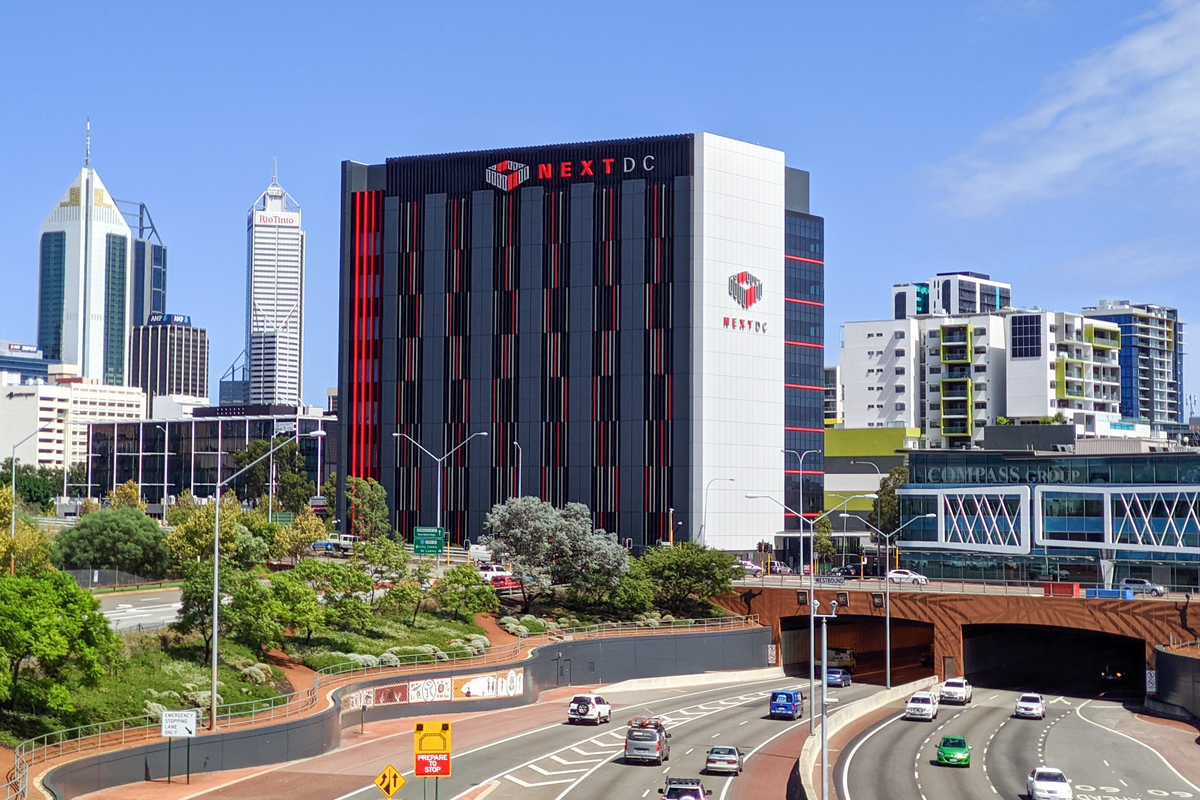
Featured image: NEXTDC’s P2 data centre in Perth (not the M3 Melbourne site discussed above), photographed in 2021 by Samuel Wiki via Wikimedia Commons, released under a CC0 1.0 public domain dedication; cropped, resized and converted to PNG. NEXTDC’s name and logo are its trademarks; no endorsement implied.