NASA’s Voyager 1 is now so far from home that a radio message takes a full day to reach it. The 49-year-old probe passed one light-day from Earth at 9:16pm AEDT on Wednesday 18 November, NASA has confirmed. No human-made object has been this far away before.
The celebration has a catch, and it was spotted in Australia. Since 14 November, Voyager 1 has sent no science or engineering data, only a bare radio tone. A Deep Space Network dish at Canberra was the one that picked up that tone, according to NASA’s Voyager mission blog. Here’s what a light-day means, what has gone wrong, and why a valley outside Canberra matters so much to the mission.
What NASA confirmed
A light-day is a distance, not a length of time. It is how far light travels in 24 hours: about 25.9 billion kilometres (25,902,068,356km, to be exact), according to NASA’s light-day explainer. Voyager 1 crossed that mark at 10:16am UTC on 18 November, which was 9:16pm AEDT, as the ABC reported.
Because the probe’s radio signal also takes a day to get here, nobody could confirm the moment as it happened. NASA’s news release says the team at the Jet Propulsion Laboratory (JPL) in California heard from Voyager 1 “24 hours later”, early on Thursday US time. Engineers used the probe’s radio signal and its known path through space to confirm the milestone.
Some numbers to put it in context, all from NASA:
- Age: Voyager 1 launched in 1977. It took 49 years, two months and 11 days to reach one light-day.
- Speed: about 61,000km/h, or roughly 38,000mph. Even at that speed, it is moving at a tiny fraction of the speed of light.
- Talking to it: a command now takes 24 hours to arrive, and the reply takes another 24 hours. Project manager Suzanne Dodd said: “We listen to Voyager 1 every day and send commands to the spacecraft weekly. It just takes a little longer to communicate than it used to.”
- Where it’s going: towards a star called AC +79 3888 (Gliese 445). Voyager 1 will pass within about 1.7 light-years of it in roughly 40,000 years.
- Its twin: Voyager 2, which took a different route past Uranus and Neptune, should reach one light-day in November 2035.
The problem: a signal, but no data
NASA’s mission blog, posted on 18 November US time, explains what went wrong. On 14 November a Deep Space Network antenna in Canberra “locked on” to Voyager 1 and received its carrier signal, the radio tone that normally carries data back to Earth. But there was no data on it.
NASA says this tells engineers two things:
- The good news: the computer that keeps the probe pointed at Earth is still working, and so are its antenna and transmitter.
- The likely problem: the onboard computer that collects readings from the science instruments and other systems, and packages them to send home. NASA hasn’t yet said what caused the fault.
Engineers are also checking whether this is linked to a scare last month. On 18 and 19 October, the Deep Space Network couldn’t hear Voyager 1 at all. The signal came back on its own on 20 October, before the team had sent any commands. NASA’s October update said a group of thrusters had gone offline and backups had switched on automatically. Voyager mission manager Kareem Badaruddin said then that “we are also at a point in the mission where we have to expect the unexpected.”
With a two-day wait for every command and reply, NASA warns that finding the cause “may take weeks or longer”. There is a hopeful precedent. In 2023, a similar data problem took months to fix. As The Register notes, engineers traced it to a faulty computer chip and worked around it with a software update, and NASA said the probe was back in action by June 2024.
Why Canberra matters to Voyager
NASA talks to its most distant spacecraft through the Deep Space Network: three sites spread around the world so one of them can always see a given part of the sky. They are at Goldstone in California, near Madrid in Spain, and at Tidbinbilla, just outside Canberra. The Canberra Deep Space Communication Complex is a NASA facility, but CSIRO manages and runs it on behalf of the Australian Government under a treaty-level agreement, CSIRO says. About 90 staff run it around the clock.
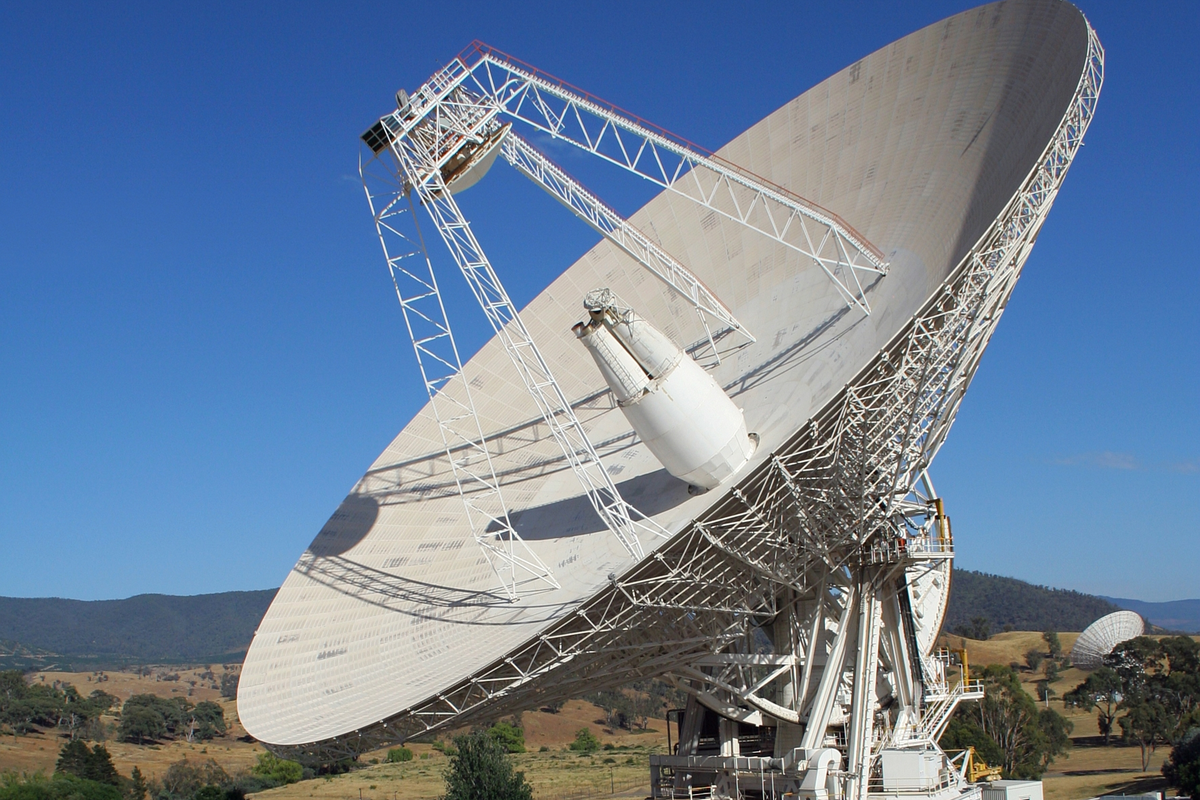
Canberra matters even more for Voyager 2, which, as the ABC notes, can now communicate only with Canberra. The complex has four working dishes, CSIRO says, including the 70-metre antenna known as DSS-43 pictured above. And it was a Canberra dish that first caught this month’s Voyager 1 problem.
It’s also a reminder that Australia already plays a hands-on part in deep space exploration, not just in launches. We looked at the country’s wider ambitions in our World Space Week explainer.
How long can Voyager 1 keep going?
Voyager 1 runs on a nuclear battery: a generator that turns heat from decaying plutonium into electricity. NASA says each probe loses about 4 watts of power a year. To save power, the team has switched off heaters and instruments over the years. Earlier in 2026, it replaced three devices on Voyager 1 with lower-power alternatives. NASA expects that to keep both probes’ current science instruments running until at least their 50th launch anniversaries next year. The probes launched in August and September 1977.
Beyond that, the outlook gets harder. Voyager project scientist Linda Spilker told the ABC: “We’ve got enough power and thermal to make it, we think, to about the early 2030s. But we also have thrusters that are clogging.” She also said of the twin probes: “They are well past the nine lives of your typical cat. It just keeps going.”
What we know, and what we don’t
- Confirmed by NASA: Voyager 1 reached one light-day on 18 November. It is still sending a carrier signal, but it has sent no science or engineering data since 14 November.
- NASA’s working theory: the fault lies with the onboard system that formats data for transmission, not with the antenna or pointing. This is NASA’s early assessment, not a confirmed diagnosis.
- Unknown: what caused the fault, whether it is linked to October’s 48-hour blackout, and whether it can be fixed remotely. NASA hadn’t posted a further update when we checked on Friday evening (AEDT).
How to follow along from Australia
- NASA’s DSN Now page shows which spacecraft each Deep Space Network dish is talking to in real time, including the Canberra antennas. When Voyager 1 is being tracked, it appears there alongside the dish assigned to it.
- NASA’s Where are Voyager 1 and 2 now? tracker shows both probes’ distance from Earth, updated live.
- The Canberra Deep Space Communication Complex has a visitor centre at Tidbinbilla. Check its website for opening hours before you go.
Our read
The light-day is a symbolic milestone. Nothing changed for the spacecraft when it passed the mark, and NASA said beforehand that it wouldn’t. The data fault is the real story. Voyager 1 has come back from worse, but each fix is slower and riskier as the probe gets older, colder and farther away. Whatever happens next, a good chunk of it will be heard first through dishes in the ACT. (For a very different kind of space news this week, see our report on the Vulcan rocket failure and Australia’s satellite internet.)
Featured image: the 70-metre DSS-43 antenna at the Canberra Deep Space Communication Complex, Tidbinbilla (2010). Photo by Robert Kerton, CSIRO, via Wikimedia Commons, licensed CC BY 3.0. Cropped and resized. Use does not imply endorsement by CSIRO or the photographer.