Jensen Huang, who co-founded Nvidia in 1993 and turned it into the company whose chips power most of the AI boom, has resigned as its president and chief executive and left its board, effective immediately. Nvidia announced the change on Thursday 12 November (US time) in a short press release that gave no reason for his departure. Chief financial officer Colette Kress is now interim CEO, and long-serving director Harvey C. Jones becomes the company’s first-ever board chair.
The resignation follows a week of damaging reports about Huang’s personal conduct and a board investigation into possible national security concerns. Nvidia shares fell sharply, and the ASX followed on Friday. Here’s what Nvidia has confirmed, what is only reported, and what it means for Australians, from super balances to the AI data centres being built here.
What Nvidia has confirmed
Nvidia’s filing with the US Securities and Exchange Commission says the board accepted Huang’s resignation as president, CEO and board member on 11 November, and announced it the following day. The confirmed details are:
- Colette Kress, 59, is interim CEO. She has been Nvidia’s chief financial officer since 2013 and will keep that job while she leads the company.
- The board is searching for a permanent CEO and says it will consider internal and external candidates. It has not given a timeline.
- Harvey C. Jones, 73, a board member since 1993 and a former CEO and executive chairman of chip-design software company Synopsys, is the board’s first chair. Until now, Nvidia’s board had no chair.
- Nvidia will still report its third-quarter results as planned on Tuesday 17 November at about 1:20pm US Pacific time, followed by an earnings call at 2pm. By our conversion, that is about 8:20am and 9am AEDT on Wednesday 18 November.
In the release, Jones said the board has “full confidence in Colette and the leadership team” and expects “the company’s operations, customer commitments and product roadmap to continue without interruption.” Kress said she was “committed to building on the extraordinary foundation Jensen created over the last 33 years.” Nvidia thanked Huang for his “immeasurable contributions” but did not say why he resigned. Reuters reports that the company has not commented beyond that statement.
Why Huang went: what he admitted, and what is only reported
The events of the past week are partly on the record and partly based on media reports, and the difference matters.
On the record. On Sunday 8 November (US time), Nvidia published an email Huang sent to staff in which he wrote: “I was unfaithful to my wife.” He said he took “full responsibility”, told colleagues and shareholders “you deserve better from me”, and asked that his family be given privacy. The same day, the board announced an independent investigation “in light of recent reporting” that Huang “has been the target of a foreign intelligence effort”. It said it had “no reason to believe that either national security or NVIDIA secrets were compromised” and that it still had confidence in Huang. On 10 November, the independent directors said they had hired former acting US Attorney Joon H. Kim and the law firm Wachtell, Lipton, Rosen & Katz to run that investigation. Nvidia has not published any findings.
Reported, not confirmed by Nvidia. According to Reuters and the Associated Press, media reports have linked Huang to a businesswoman who is a former executive of a Singapore-based Nvidia cloud partner, and whom US intelligence officials reportedly suspect of working for Chinese intelligence. Beijing denies that. Reuters reports that US Attorney General Todd Blanche said on Thursday the Justice Department had not yet reached a conclusion on whether she was a spy. The New York Times then reported on Wednesday that Huang had also had a relationship with a senior Nvidia executive who reported to him, according to Axios and CNBC. Reuters separately reported a relationship with a second Nvidia employee, citing two people familiar with the matter. Nvidia declined to comment. We are not naming the women involved.
Nvidia has not linked the resignation to any of these reports, and its board investigation has not published any findings.
How the market reacted, in the US and here
Nvidia shares fell as much as 13% to 14% (depending on the report) after Thursday’s open in New York before recovering to close 4.3% lower, according to Reuters and the AFR. Rivals AMD and Broadcom rose about 6% each. The ABC reported that retail investors bought about US$111 million worth of Nvidia shares in the first 30 minutes of trading, citing Vanda Analytics. Reuters says demand for AI computing drove a sevenfold rise in Nvidia’s shares through early October, pushing its market value to nearly US$6 trillion at one point. Huang holds about 3.61% of the company, making him its fourth-largest shareholder.
In Australia, the S&P/ASX 200 was down 0.9% at 9,064 points at 11:58am AEDT on Friday, with technology, mining and real estate shares leading the falls, the AFR reported. It said the Australian dollar had fallen to a 10-month low as Huang’s exit dented appetite for risk. The ABC put the dollar at 68.05 US cents at about 11:21am.
Many Australians own a little Nvidia without knowing it. Because Nvidia is one of the world’s largest listed companies, it is a large holding in global share index funds. The Nightly notes it is a favoured holding of big super funds including AustralianSuper, Aware Super, Australian Retirement Trust and Care Super. How much any one member is exposed depends on their fund and investment option, so check your fund’s holdings disclosure rather than guessing.
Who is Colette Kress, and will she keep the job?
Kress joined Nvidia in September 2013 after finance roles at Cisco, Microsoft and Texas Instruments, and has long been Huang’s partner on earnings calls. CNBC quotes Yorkville Ives analyst Dan Ives describing her as “more than just a CFO”. Ives expects her to serve for about a year, with the permanent CEO coming from outside the company. That is his forecast; Nvidia has said nothing about timing. Reuters reports that investors and analysts had already named Kress and long-time Nvidia engineer Ian Buck as the leading internal candidates.
In a memo to staff quoted by Reuters, Kress wrote: “The Board, Estaff (executive staff) and I recognize that this has been an extraordinarily difficult period.” She said the company would hold a staff meeting on 18 November.
The analysts quoted so far mostly argue that Nvidia’s products are not suddenly at risk, but how well the company is run might be. “The risk is not that Nvidia suddenly loses its technology roadmap … The risk is execution,” ClearBridge Investments portfolio manager Michael Feldman told Reuters. “Jensen has been the chief conductor of an extraordinarily complex system.” Ives, who cut his share price target from US$300 to US$225 while keeping his outperform rating, has said that “the demand trajectory the next few years is not changing because Jensen is gone,” according to the ABC.
The Washington and China angle
The resignation does not end the political pressure. Reuters reports that Senate Banking Committee chair Tim Scott has called on Huang and Commerce Secretary Howard Lutnick to testify next month, that US House Speaker Mike Johnson said there was a growing consensus on limiting chip exports to China, and that senior White House officials are discussing Lutnick’s future. A White House official said earlier that President Donald Trump “maintains complete confidence” in Lutnick. Senator Elizabeth Warren said Huang’s decision to resign “does not absolve him, other executives, or the company as a whole of responsibility”, Axios reports.
In our view, that matters beyond the US: tighter export rules can change where Nvidia’s most advanced chips can be sold and how many are left for other markets. Any new rules, though, are still hypothetical.
What it means for Australians
- Local AI infrastructure. Nvidia is supplying technology to a group of Australian data-centre and cloud companies, including Firmus, Sharon AI, IREN, NEXTDC, CDC and AirTrunk, for planned AI capacity of up to 2 gigawatts. Nvidia’s board says customer commitments and the product roadmap will continue without interruption. We have not seen any Australian partner announce a change because of the resignation.
- Gamers and PC buyers. Nvidia has not announced any change to GeForce graphics cards, drivers or pricing. In our view, there is no reason to delay a purchase because of this news alone.
- Super and investors. Expect more volatility in AI-linked shares around Nvidia’s results on Wednesday morning, 18 November (AEDT). Anyone weighing Anthropic’s Australian share offer, which closes at 5pm AEDT on Tuesday 17 November, should note it closes the afternoon before those results arrive. This is general information, not financial advice.
- The wider AI trade. Reuters notes that Nvidia has poured its cash back into cloud providers, suppliers and AI labs. The ABC quoted Business Insider’s Katie Notopoulos describing Nvidia as a “giant cash spigot for the entire AI industry”. Fewer or smaller Nvidia deals would add to the doubts about AI spending we wrote about last week.
Our read
This is our analysis. Nvidia’s chips, software and supply deals don’t disappear with Huang. Its product plans are largely public for the next few years, and analysts such as Ives still rate it years ahead of its nearest rivals. The bigger risk is that Nvidia was unusually built around one person: as CNBC notes, Huang ran it with no clear second-in-command and personally decided which projects were priorities, and the company had no board chair until this week. A CFO leading as interim CEO, a newly created chair and an investigation with no findings yet add up to a period of uncertainty, not a collapse.
The first real test is next Wednesday morning, Australian time. Watch whether Nvidia changes its outlook, what Kress says about the CEO search and the investigation, and whether customers and partners signal any hesitation. Until those questions are answered, treat confident predictions about Nvidia’s next CEO or its share price with caution.
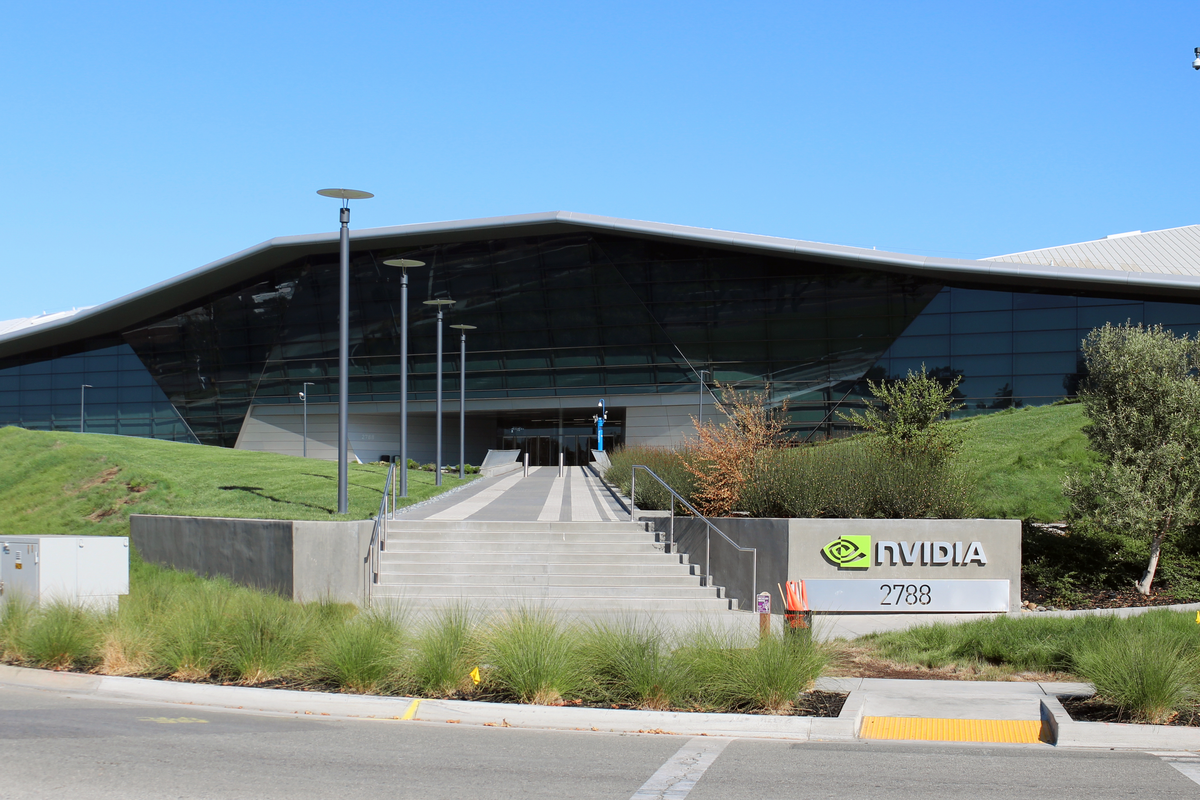
Featured image: Nvidia’s Endeavor building at its headquarters in Santa Clara, California (photographed in 2018; stock photo, not taken during this week’s events). Photo: Coolcaesar via Wikimedia Commons, CC BY-SA 4.0; cropped, resized and converted to PNG. The Nvidia logo is a trademark of Nvidia Corporation, shown for editorial purposes; no endorsement implied.