Sydney quantum software company Q-CTRL has raised US$290 million in a Series C round led by Salesforce Ventures, pushing its valuation past US$1 billion and making it, by the federal government’s own description, Australia’s first quantum unicorn. Australian taxpayers are in on the deal too: the National Reconstruction Fund Corporation (NRFC) has taken a $70 million equity stake.
Q-CTRL announced the round on 12 November (US time; around midnight on 13 November AEDT). It hasn’t disclosed its exact valuation or its revenue. Here’s what was confirmed, what the company actually sells, and which of its big claims you should treat as claims.
The deal in numbers
- US$290 million Series C. That’s about A$424 million at the Reserve Bank’s 12 November exchange rate (our conversion), which matches the figure the AFR used. Q-CTRL’s own release quoted A$415 million.
- Valuation above US$1 billion. Q-CTRL declined to give Forbes Australia an exact figure. The NRFC release also says “over US$1 billion”.
- Lead investor: Salesforce Ventures, with what Q-CTRL calls “significant participation” from Bullhound Capital and Affinity Partners.
- New investors: Affinity Partners, AMD Ventures, EDGE Group, MPower Partners, the NRFC and SPARX Asset Management.
- Returning investors: Alpha Edison, Alumni Ventures, Bullhound Capital, DCVC, In-Q-Tel, Lockheed Martin Ventures, Main Sequence, Ridgeline, Salesforce Ventures, Salus Ventures and Square Peg.
- Taxpayer stake: A$70 million in equity from the NRFC, its fifth investment in quantum technology.
Q-CTRL says the round was oversubscribed and expanded twice to meet demand, and calls it the largest quantum-sector raise for a software-focused business. Founder and chief executive Michael Biercuk told Forbes Australia that the size originally set by the lead investor was “much, much smaller”, though he wouldn’t say by how much. For scale, a Forbes contributor notes Q-CTRL’s entire Series B, raised in tranches from 2021 to 2024, came to US$113 million.
The investor list leans heavily towards chips, defence and aerospace. Quartz, citing Bloomberg, identifies Affinity Partners as the investment firm founded by Jared Kushner; EDGE Group is an Abu Dhabi defence conglomerate, and In-Q-Tel is the venture arm that invests on behalf of US intelligence agencies.
What Q-CTRL actually does
Q-CTRL was founded in 2017 by Biercuk, a US-born academic who joined the University of Sydney in 2010, and it began as a university spin-out. Rather than build its own quantum computer, it makes software that suppresses the noise and errors that make quantum hardware so fragile. Forbes Australia reports that he deliberately made its software “hardware agnostic”, because, as he put it, “nobody knows” which type of quantum computer will win.
That same approach underpins its two main businesses:
- Quantum navigation. Its Ironstone Opal system uses quantum sensors to read tiny variations in the Earth’s magnetic field (or, in one maritime trial, in gravity) and match them against maps, so an aircraft, drone or vehicle can work out where it is without GPS. Q-CTRL says it is being deployed on commercial aircraft with Airbus, in autonomous platforms with Lockheed Martin and on unmanned drones.
- Quantum computing software. Q-CTRL licenses software that makes existing quantum computers more stable and more likely to return a correct answer. Biercuk told Forbes Australia it earns money from clients in logistics, stock picking and biopharma.
Navigation is where the money and the urgency are. GPS signals are easy to jam or spoof, and Quartz notes that jamming and spoofing have degraded satellite navigation amid the conflicts in Ukraine and the Middle East. Forbes Australia reports that GPS jamming went from negligible in 2020 to affecting around 1,500 flights a day now. According to Quartz’s summary of Bloomberg’s reporting, Biercuk says Q-CTRL counts DARPA, the Australian and British navies and Airbus among its contract customers. Q-CTRL has been selling a pre-production evaluation kit, and Biercuk says the production version is due in early 2027.
The claims to treat with care
Q-CTRL’s announcement is bold. It says its quantum navigation system is “unjammable, unspoofable, and undetectable”, that its sensors perform “100 times better than the best alternative” in the field, and that it has already reached “quantum advantage” in both sensing and computing.
These are company claims, and independent detail is limited. Forbes Australia reports that in March, Q-CTRL software running on an IBM quantum computer completed a materials-science simulation in about two minutes that took more than 100 hours using a leading conventional method, with results within 1 per cent. But Biercuk declined to give Forbes Australia precise details of the navigation tests, citing commercial and government confidentiality, and the company hasn’t disclosed revenue. As the Forbes contributor put it: “we have no real way of knowing how much it is.” The “100 times” figure is a comparison against the best existing GPS backups, not against GPS itself.
Why the Australian government bought in
The NRFC is a Commonwealth entity with $15 billion to invest in Australian manufacturing capability. In its 13 November release, it said the money will support Q-CTRL’s research and development in Australia and expand its local workforce. Q-CTRL has more than 150 staff in Australia, who lead its quantum sensing work, out of more than 225 worldwide. The NRFC also notes that quantum navigation is a priority capability for Australia, the US and the UK under AUKUS Pillar II.
NRFC chief executive David Gall said the investment “secures the nation’s quantum supply chain and the expertise we need to keep Australia at the forefront of quantum technology into the future.” Biercuk called Q-CTRL “a global business with Australian roots”.
Forbes Australia lists the NRFC’s four earlier quantum investments as Quantum Brilliance (A$13 million), QuintessenceLabs (A$15 million), Diraq (A$20 million) and Silicon Quantum Computing (A$60 million), which on those figures makes the Q-CTRL stake its largest quantum investment so far. Unlike Anthropic, whose IPO offer is open to Australian retail investors until 17 November, Q-CTRL is still privately held, so ordinary investors can’t buy its shares on a stock exchange. The NRFC stake does, however, give taxpayers indirect exposure to how it performs.
Our read
In our view, this is a genuinely significant moment for Australian deep tech: a homegrown quantum company has raised serious global money on the strength of a product that is already being trialled on aircraft, not just on a promise of future quantum computers. GPS-free navigation solves a real and growing problem, which helps explain why defence and aerospace investors crowded in. The caveats matter, though. Q-CTRL hasn’t published its revenue or valuation, much of its navigation testing is confidential, and the production hardware isn’t due until 2027. The next year will show whether the “unicorn” label is backed by sales.
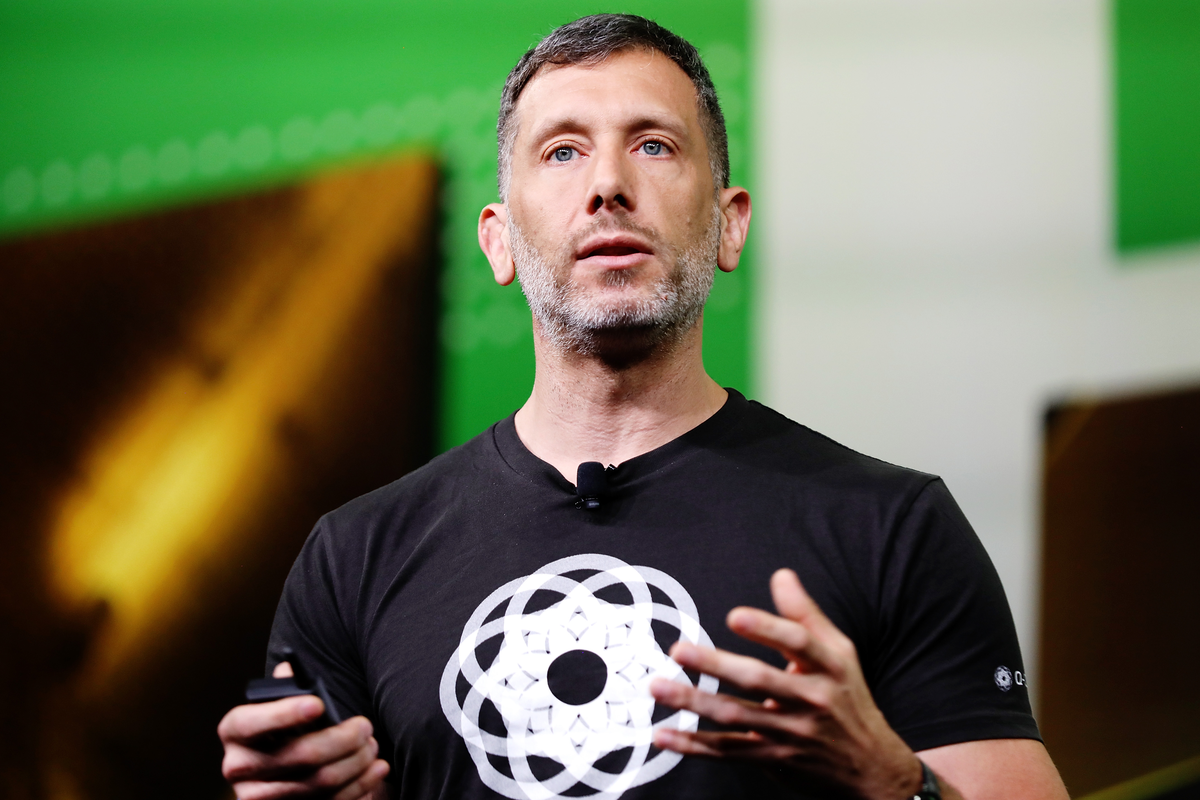
Featured image: Q-CTRL founder and chief executive Michael Biercuk speaking at TechCrunch Disrupt 2022 in San Francisco (2022 photo, not supplied by Q-CTRL). Photo: Kelly Sullivan/Getty Images for TechCrunch, via Wikimedia Commons, licensed under CC BY 2.0; resized and converted to PNG. Currency conversion uses the RBA’s 12 November 2026 rate of A$1 = US$0.6841.