SpaceX’s Starship has reached orbit for the second time and released all 26 of its new, larger Starlink V3 internet satellites. But Flight 15 is only half done. The rocket lifted off from Starbase in South Texas at about 4:47pm local time on Friday 13 November, which was about 9:47am on Saturday in Sydney. Its Super Heavy booster called off a planned catch by the launch tower and came down in the Gulf of Mexico instead. The upper stage, Ship 42, is now circling Earth ahead of SpaceX’s first attempt to catch a Starship upper stage, due early on Sunday morning, Australian eastern time.
Here’s what has been confirmed, what still has to happen, and why it matters for the hundreds of thousands of Australians now using Starlink.
What happened on Flight 15
According to Space.com’s launch report, the booster’s 33 Raptor 3 engines got the rocket off the pad cleanly. About 26 minutes after launch, a burn of roughly 20 seconds put the ship into low Earth orbit at around 275 kilometres. “We’ve got a nominal orbit insertion, so Starship now in orbit around Earth for the second time ever,” SpaceX’s Dan Huot said on the launch webcast. The first time was Flight 14, which launched on 28 September (US time).
The booster did not go to plan. SpaceX intended to catch Super Heavy Booster 22 with the tower’s “chopstick” arms about six and a half minutes after launch. It would have been the first catch attempt for a Version 3 booster, according to SpaceX’s Flight 15 mission page. Instead the booster was sent offshore. Spaceflight Now reported that it exploded as it came down offshore. SpaceX hasn’t explained why the catch was called off. “We’ll dig in to what caused that abort during its flight back to the tower,” Huot said. SpaceX says it has caught three earlier first-generation boosters and flown two of them again.
The main job went smoothly. Starship released the 26 Starlink V3 satellites one at a time through a narrow door near the base of the ship, starting about 35 minutes after launch. All were out by about 1 hour 17 minutes, according to Space.com’s live coverage. Ars Technica reports that each satellite’s solar panels stretch about 60 metres end to end once unfolded. The satellites will now use their own thrusters to raise their orbits.
What still has to happen
SpaceX’s plan is for the ship to orbit Earth about 14 times over more than 22 hours. It will only head back to Starbase if controllers are satisfied that the systems needed for re-entry, the landing burn and the approach to the tower are healthy. Three of the Starlink satellites carry cameras designed to photograph the ship’s heatshield after they are released, which gives controllers one more way to judge whether it is safe to try. SpaceX says this ship also carries improved heatshield tiles: tiles in the areas most at risk of falling off have extra retention mechanisms, and a large portion of the heatshield uses a curved tile design meant to reduce heating in the gaps between tiles.
Converted from SpaceX’s published flight timeline, the key moments in Sydney time (AEDT) are roughly:
- about 5pm Saturday 14 November: the second of three checkpoints where SpaceX can choose to end the flight early in the ocean (off Chile)
- about 6:30am Sunday 15 November: the final checkpoint (off Hawaii)
- about 7:20am Sunday: the deorbit burn, if the ship is cleared to come home
- about 8:20am Sunday: landing burn and the attempted catch by the Starbase tower
These times are approximate and could change. SpaceX has never tried to catch a Starship upper stage. If anything looks wrong, Spaceflight Now says the ship can be brought down in the ocean off Hawaii or Chile instead, and Space.com says SpaceX has also set aside a backup splashdown zone in the Gulf of Mexico. As of the latest Space.com update we could see (about 12:30pm AEDT on Saturday), the ship was flying over Southeast Asia and the Indian Ocean at about 260 kilometres. Controllers had already skipped the first early-return option, making this the longest Starship flight so far. “That means this is now going to be the longest Starship mission we’ve ever flown,” Huot said.
Why Starlink V3 matters
Starlink V3 is SpaceX’s next generation of satellite, and it launches on Starship rather than on the Falcon 9 rockets that carry the current V2 Mini satellites. SpaceX claims each V3 satellite adds 1 terabit per second of capacity to the network, and that these 26 add as much as about 10 Falcon 9 launches of the current V2 Mini satellites. SpaceX also says the satellites “should begin serving customers as soon as a few weeks after launch” once they pass on-orbit checks. These figures come from SpaceX and haven’t been independently verified. SpaceX also hasn’t said how the new capacity will be shared between countries.
For context, Space.com says more than 11,000 of the older V2 satellites are already in low Earth orbit. This is the second batch of V3s, after the 26 launched on Flight 14. According to Space.com, Elon Musk has said the next-generation constellation will be about 100,000 satellites, which is one reason SpaceX needs Starship to be fully reusable. That is Musk’s stated plan, not a confirmed deployment schedule.
What it means in Australia
Starlink is now a major part of Australian broadband. In a June 2026 speech, ACCC Commissioner Anna Brakey said Starlink’s retail subscribers grew from 375,000 in June 2025 to 552,000 in December 2025. “Starlink is now the second largest network providing services in Australia after NBN,” she said. She also noted that NBN Co has announced a wholesale satellite arrangement with Amazon to eventually move users off its Sky Muster satellite service. That makes the low Earth orbit broadband market a real contest here, not just a Starlink story.
For Starlink customers, the practical point is capacity. More satellites with more bandwidth should, in principle, ease congestion and support faster speeds as subscriber numbers keep growing. But neither SpaceX’s mission material nor any announcement we have seen says anything about changes to Australian service, plans, prices or dish requirements. Don’t expect anything to change on your bill or in your app because of this launch.
If you want the bigger picture, our earlier piece on the reusable rocket revolution and Australia’s space ambitions explains why recovering and reflying rockets matters so much. Starlink is also turning up in more places beyond the home, such as the in-flight Wi-Fi Emirates is rolling out across its fleet.
Our read
Our read: Ars Technica argues that, after this deployment, Starship is now “an operational, orbital rocket.” That is fair as far as payload delivery goes. But the whole case for Starship rests on reusing both stages quickly and cheaply, and Flight 15 has already missed half of that goal with the booster. Sunday morning’s attempt to catch the ship matters more for SpaceX’s long-term costs than for anyone’s Starlink connection this year. For Australian users, the useful milestone is quieter: whether these V3 satellites start carrying traffic within weeks, as SpaceX says they should. That would be the first real sign that Starship is adding capacity, rather than just promising it.
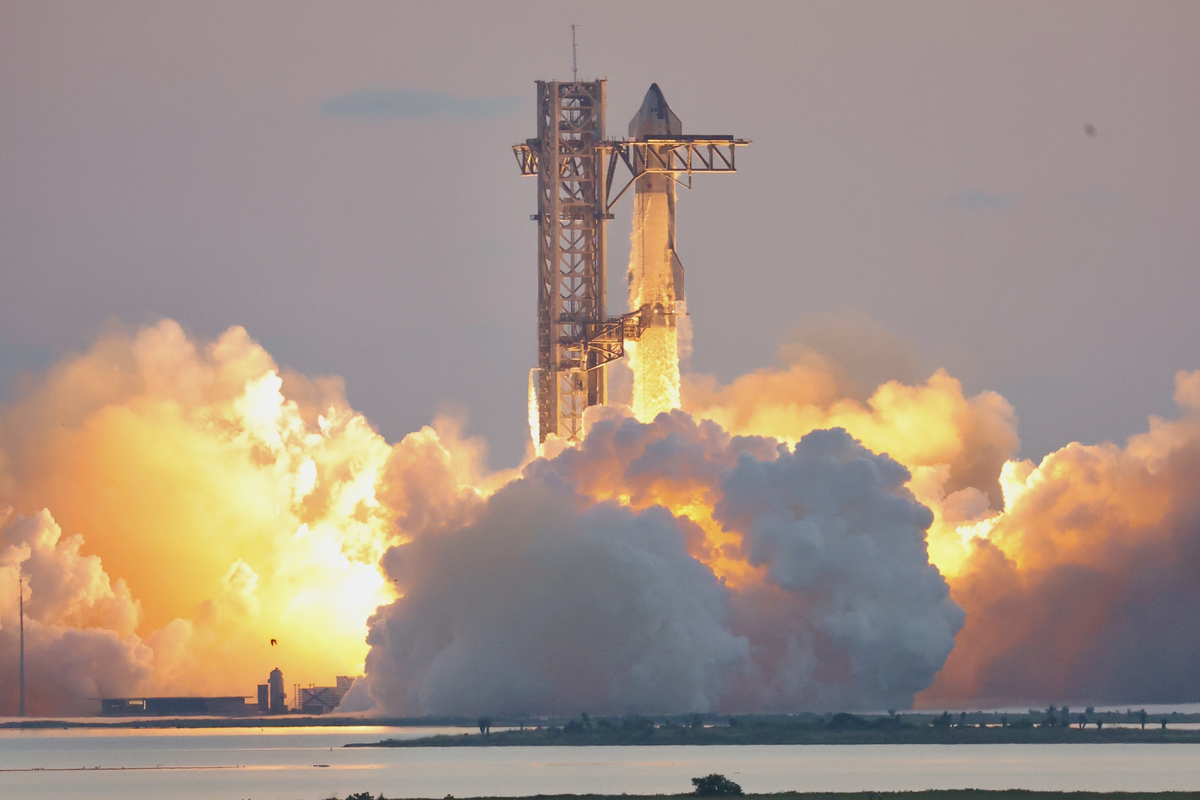
Featured image: Starship lifting off on its fifth flight test from Starbase, Texas, in October 2024 (not Flight 15; not supplied by SpaceX). Photo: Steve Jurvetson, via Wikimedia Commons, CC BY 2.0; cropped, resized and converted to PNG.