California has barred Waymo’s driverless cars from every freeway in the state, and Waymo has now pulled them off freeways in all of its US markets. The state’s Department of Motor Vehicles (DMV) says the robotaxis pose an “imminent hazard to public safety” after repeatedly driving into active roadworks. The order was dated 11 November in California but only became public on Tuesday US time, which was Wednesday morning in Sydney, according to TechCrunch.
Waymo does not operate in Australia, so nothing changes on local roads. But the company has been lobbying Australian governments for a trial, and the episode is a live example of the kind of regulator action Australia’s planned driverless-car laws are meant to allow. Here is what happened, what is still unknown, and where Australia stands.
What California ordered
The DMV told TechCrunch it acted after three Waymo vehicles entered an active construction closure on US Route 101 near Burlingame, south of San Francisco, and after a separate incident involving California Highway Patrol vehicles on Highway 280 in San Francisco. The Guardian dates those incidents to 5 and 6 November respectively, and says the restrictions bar Waymo from “operating or testing its driverless vehicles on all California freeways”. The Verge and TechCrunch put the start of the restriction at 11 November.
In a statement, the DMV said: “The Department determined that Waymo’s driverless freeway operations pose an imminent hazard to public safety due to recurring incursions by its vehicles into active construction zones where construction workers, vehicles and equipment are present, despite a prior restriction and corrective actions implemented following similar incidents that occurred on May 18, 2026.”
The restriction stays until Waymo shows the DMV it has taken “effective corrective actions”, TechCrunch reports. According to Gizmodo, the DMV said Waymo must provide sufficient evidence that its vehicles can detect and respond to construction zones, emergency vehicles and other roadway situations.
What Waymo says
Waymo’s position, as quoted by TechCrunch, is that the US 101 encounters “did not involve any injuries or collisions”. It has complied, and spokesperson Dana Gallagher said: “In alignment with our safety-first principles, we have also temporarily restricted freeway operations across our other operating markets to evaluate our performance.” TechCrunch says Waymo currently runs commercial service in 15 US cities.
Waymo also told Gizmodo that its “ride-hailing service continues to operate safely on surface streets, serving over half a million trips each week”, and that it is working with the DMV and other officials to resume freeway operations. That is the company’s own claim; we have not seen independent figures. Waymo had not given a timetable for resuming freeway rides in the coverage we reviewed.
Why freeways matter, and what we don’t know
Freeway rides began in November 2025, according to the Verge, and TechCrunch calls them central to Waymo’s expansion because they connect riders to airports and cut trip times. In the San Francisco Bay Area, TechCrunch says, they shortened Peninsula trips that previously took 45 minutes or more than an hour. The Verge adds that without freeways Waymo must use longer local routes, which could push fares up, and that its rides already cost more on average than human-driven Uber or Lyft trips.
This is not the first stoppage. The Verge reports Waymo voluntarily paused freeway operations in May 2026 over construction-site concerns and resumed in late July; TechCrunch says the company then said it had updated its software to better handle freeway construction zones.
- Unknown: how long the restriction will last. The DMV set no date, only a requirement for evidence.
- Unknown: exactly what Waymo’s corrective changes will be, or whether regulators outside California will act. The Verge describes Waymo’s pause in its other markets as voluntary.
- Unverified: Gizmodo also points to viral video of a Waymo caught between railroad crossing gates in San Diego. Waymo did not respond to its questions about that clip, and it is not part of the DMV’s stated reasons.
What it means for Australia
Not yet available here is the key point. The federal infrastructure department says: “Current Australian laws do not allow for the use of automated vehicles on public roads.” The National Transport Commission says automated vehicles are “not yet available commercially or for general use on public roads in Australia”. Trials run under state and territory frameworks.
Transport ministers agreed on 21 November 2025 to allow conditional deployment of automated vehicles from 2027 in selected locations, the NTC says, depending on each state and territory updating its laws. The planned Automated Vehicle Safety Law would put responsibility for an automated driving system on a certified company, called the Automated Driving System Entity, overseen by a new regulator. The department says this will include safety duties on that entity once the framework is in place.
Waymo has been working on it. Information Age reported in January, citing freedom-of-information documents, that Waymo was talking to Australian regulators about testing as soon as this year. In June, 7NEWS reported that Transport for NSW was “monitoring developments” and that “no decisions have been made”, while NSW Premier Chris Minns said: “My personal view is that that would be a good thing for Sydney.” The Australian Financial Review reported on 28 June that NSW documents showed Waymo had been warned of a seven-stage approval process expected to take several years. We found no approved Waymo trial in Australia.
For Australian readers, the practical takeaway is simple: you cannot ride a Waymo here, and a trial or launch date has not been set. The DMV action shows the sort of conditions regulators may impose once these cars arrive. For a sense of how slowly even driver-assistance technology is moving, see our earlier report on Hyundai turning to NVIDIA as its own driver-assistance software slipped to 2029.
Our read
This is analysis, not reporting. A regulator calling a driverless service an “imminent hazard” after a repeat problem, and the company then pausing freeways nationwide, is the strongest public test yet of how fast a US state will act on robotaxi safety. Waymo’s response was quick, and no injuries were reported. But the DMV’s wording about “recurring” incursions “despite a prior restriction” sets a high bar for the company to clear. For Australia, the lesson is that approvals will probably be conditional and revocable, so any local launch will depend on how quickly operators can show regulators fixes, not only on when the laws pass.
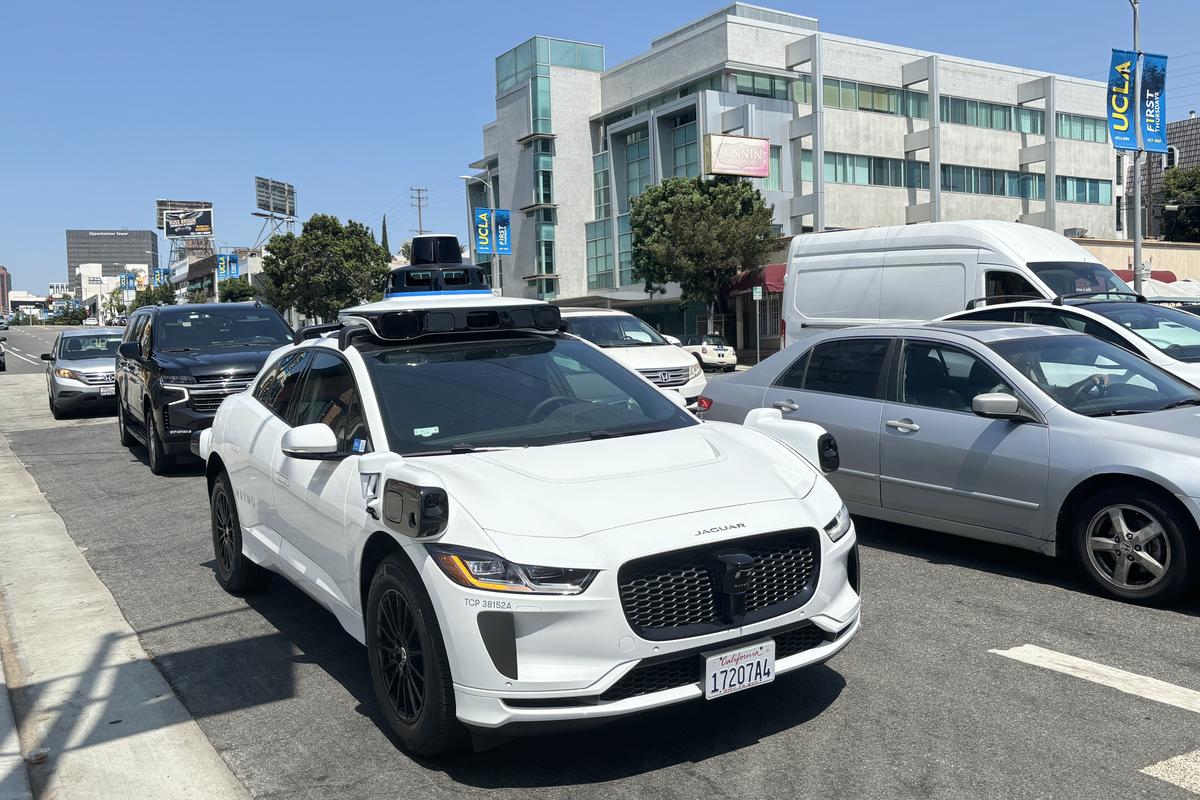
Featured image: a Waymo Jaguar I-Pace on Westwood Boulevard, Los Angeles, photographed in August 2024 (file photo; it does not show the California freeway incidents). Photo: Alexis Doine / Wikimedia Commons / “Jaguar I-Pace (Waymo) on Westwood Boulevard (2024)” / CC0 1.0. Cropped to 3:2, resized and converted to PNG.