After more than eight years in space, the European–Japanese BepiColombo mission is finally in orbit around Mercury. The two linked spacecraft fired their way into a looping orbit around the smallest planet on Saturday 21 November (early Sunday morning in eastern Australia), making BepiColombo only the second mission ever to orbit Mercury, after NASA’s MESSENGER in 2011–2015, according to Nature. The European Space Agency (ESA) announced the arrival on social media, AP reported.
It is a milestone, not the finish line. The two science orbiters are still stacked together, they won’t split up until December, and proper science doesn’t start until April 2027. Here’s what happened, why Mercury is so hard to reach, what comes next, and where Australia fits in.
What happened on Saturday
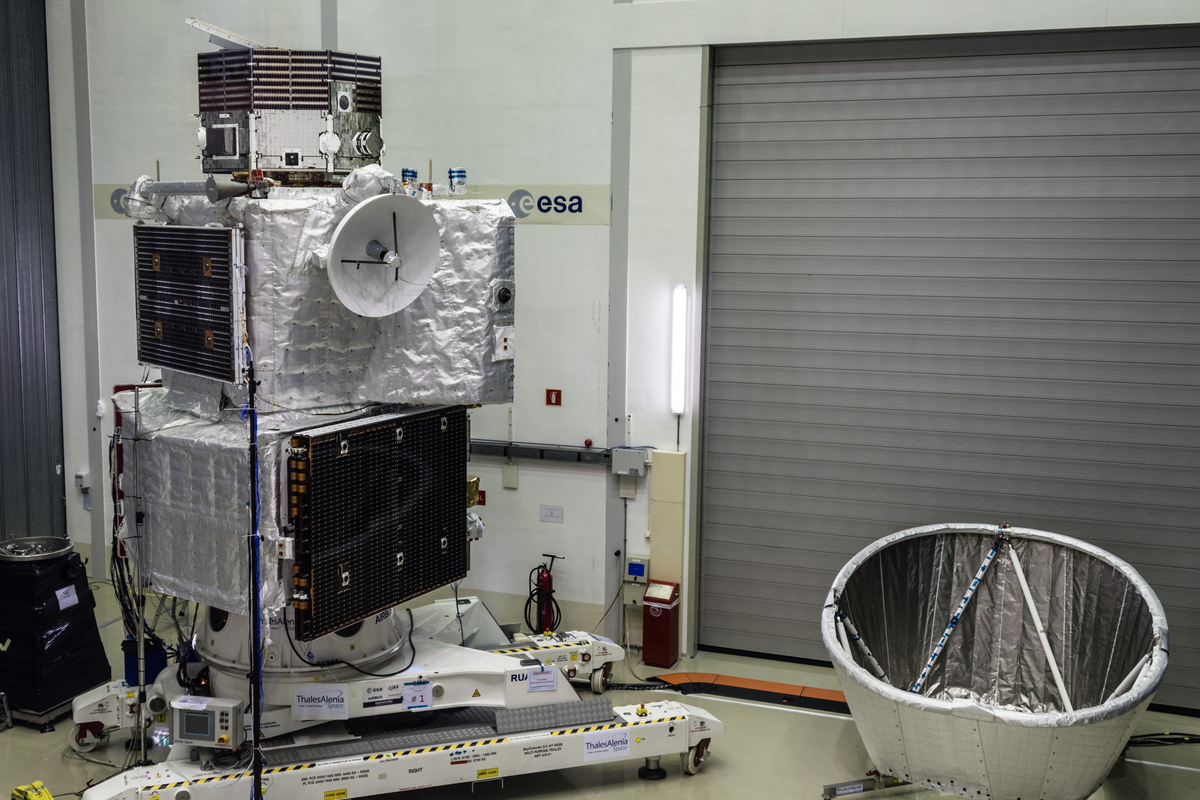
BepiColombo is a joint mission of ESA and the Japan Aerospace Exploration Agency (JAXA). The spacecraft that arrived is a stack of two orbiters: ESA’s Mercury Planetary Orbiter (MPO) and JAXA’s Mercury Magnetospheric Orbiter, known as Mio, which rides inside a sunshield. The propulsion module that carried them most of the way, the Mercury Transfer Module, was jettisoned on 3 September, leaving MPO to do the steering, according to ESA’s arrival updates.
The orbit-insertion burn was scheduled to start at 18:24 GMT on Saturday and run for 37 minutes, Space.com reported. That’s 5:24am AEDT on Sunday 22 November in Sydney and Melbourne, or 2:24am in Perth. In ESA’s description of the manoeuvre, four of MPO’s thrusters fire to slow the stack as it approaches Mercury’s south pole from the planet’s night side, so that Mercury’s gravity captures it into an initial elliptical orbit of 590 x 11,640 km.
ESA’s own live-updates page had not yet posted a detailed account of the burn when we checked on Sunday afternoon (AEDT), but AP, Nature and Eos, the American Geophysical Union’s news site, all report that the spacecraft is now in orbit. ESA has scheduled a media briefing on the mission’s status for Friday 27 November at 09:30 GMT (8:30pm AEDT), with speakers from ESA, JAXA and Airbus.
Why Mercury is so hard to reach
Mercury is one of the hardest planets to get into orbit around. A spacecraft falling inwards towards the Sun picks up enormous speed and has to shed most of it to be caught by a small planet with weak gravity.
“Reaching Mercury is actually harder than reaching Pluto,” Azul Pinochet-Barros, an editor for operations activities at ESA’s European Space Operations Centre, said during the September livestream of the transfer module’s separation, as quoted by Eos. “The challenge isn’t getting closer to the Sun. It’s losing enough energy to match Mercury’s path around the Sun.” University of Leicester physicist Emma Bunce, one of the mission’s lead scientists, put it this way to Nature: “Energetically, it takes more energy to go to Mercury than to go to the outer Solar System.”
BepiColombo’s answer was a long, looping route. After launching on an Ariane 5 from French Guiana in October 2018, it made one flyby of Earth, two of Venus and six of Mercury itself, each one bleeding off speed, according to Space.com. The trip was stretched by about a year after a 2024 problem meant the transfer module’s electric thrusters couldn’t run at full power, pushing arrival from December 2025 to November 2026, Eos reports. AP puts the mission’s cost at about US$2 billion (€1.7 billion).
What happens next
The arrival is staged over months. ESA’s published timeline, which it notes may change for operational reasons, is:
- 9–10 December 2026: MPO releases Mio into its own elliptical polar orbit. From then, BepiColombo becomes the first mission flying two spacecraft around Mercury at once.
- 16 December 2026: MPO drops Mio’s sunshield and begins lowering its own orbit with its thrusters.
- 10 March 2027: MPO reaches its final science orbit.
- 6 April 2027: the science phase begins.
The two orbiters will work from very different vantage points. ESA’s spacecraft documentation says MPO will settle into a polar orbit of about 480 x 1,500 km, taking roughly 2.3 hours per lap, while Mio’s orbit will take about 9.3 hours. Eos says the nominal mission lasts a year, with a planned extension through 2029.
What BepiColombo will study
MPO is the mapping spacecraft. Its instruments will chart Mercury’s heavily cratered surface, its composition and temperature, its topography and its gravity field, and a radio science experiment will help pin down the size of the planet’s unusually large iron core. Mio is focused on the planet’s magnetic field and the space around it. Mercury has a magnetic field, but scientists don’t understand what keeps it going or why it is offset from the planet’s centre, Eos notes.
ESA’s mission description, quoted by Space.com, sums up the goal: “The data will enable scientists to understand more about the origin and evolution of a planet located close to its parent star, and a better understanding of the overall evolution of our solar system.”
Several of MPO’s instruments have already been checked out. On 15 September they were all switched on together for the first time since the transfer module left, and ESA said the first analyses showed them in good health, including the BELA laser altimeter, the MERTIS thermal imaging spectrometer and the SIMBIO-SYS camera. Nature reports that the mission’s X-ray imager, MIXS, which Bunce describes as the first X-ray imaging device sent on an interplanetary mission, was tested on the Crab Nebula during the cruise.
The Australian connection
BepiColombo has a direct line to Western Australia. ESA’s deep-space station at New Norcia, about 130 km north-east of Perth, is one of only three in the agency’s deep-space tracking network, alongside Cebreros in Spain and Malargüe in Argentina, and CSIRO has run its day-to-day operations and maintenance since June 2019. CSIRO lists BepiColombo among the missions the station supports.
New Norcia was the station that picked up BepiColombo’s first signals after launch in October 2018, according to ESA’s mission operations page, and ESA’s spacecraft documentation names New Norcia among the backup stations for critical phases during cruise and Mercury capture, with Cebreros in Spain as the primary station. ESA has not said which antennas were listening during Saturday’s burn, so we can’t say whether the Australian dish played a part this time. The station gained a second 35-metre antenna in 2025, a collaboration between ESA and the Australian Space Agency, CSIRO says.
New Norcia is separate from the NASA-owned Canberra Deep Space Communication Complex at Tidbinbilla, which CSIRO also runs and where a dish recently picked up the signal that revealed a data problem on Voyager 1. For more on how deep-space missions are kept running from the ground, see our report on the pause in science on NASA’s Perseverance rover and Mars Odyssey orbiter.
Our view (analysis): Getting into orbit was the riskiest single step of the arrival, and on the reports so far it has gone to plan. But the mission’s payoff depends on the next few months going smoothly, especially Mio’s release in December and MPO’s long series of burns down to its science orbit. The best indicator of how things are going will be ESA and JAXA’s briefing on 27 November. If it confirms a healthy spacecraft, Mercury’s first two-spacecraft exploration should begin in April, with Australia’s New Norcia station one of the dishes ready to support it.
Featured image: BepiColombo in launch configuration at ESA’s test centre in Noordwijk, the Netherlands, in July 2017, with JAXA’s Mio orbiter on top, ESA’s Mercury Planetary Orbiter in the middle and the transfer module at the base; Mio’s sunshield sits on the floor at right. Photo: ESA–C. Carreau, via Wikimedia Commons, licensed CC BY-SA 3.0 IGO (cropped and resized).