Flight Centre Travel Group says a third-party system its leisure brands use to book accommodation has been breached, and that “a significant number of customer records” may have been accessed. The Brisbane-based company told the ASX on Thursday 26 November that most of those records hold little more than a name, but a small share include passport details, dates of birth or contact information, and in rare cases health or mobility information.
No payment details have been found to be affected so far, and existing bookings go ahead as normal. The company says it will contact affected customers. Until it does, the biggest practical risk for most people is a convincing scam message that quotes a real booking, so it is worth knowing what to look out for.
What Flight Centre has confirmed
The ASX statement, authorised by the board, says FLT is “investigating unusual activity in a third-party accommodation booking system used by some of its leisure travel brands”. Those brands are the Flight Centre brand, Travel Associates and Cruiseabout, plus some independent agents that use the same system.
The company is careful to limit the scope. It says “Flight bookings are not impacted” and that corporate travel bookings “are made through other systems and are not affected”. So the incident concerns hotel and other accommodation bookings made through those retail brands, not airline tickets or business travel handled by its corporate arm.
On the data itself, FLT believes “a significant number of customer records in the impacted system may have been accessed by unknown persons”, but adds that “it is not clear at this time how many of those records have actually been extracted from the third-party system.” Its initial review found most accessed records “comprise only customer names, some with basic travel information.” A “very small percentage” is believed to include “limited passport details, email addresses, phone numbers, birth dates, or in rare cases health or mobility information.”
“To date, no access to customer credit card, payment or bank account details has been identified,” the statement says. Travel Associates’ customer FAQ, updated at 3.30pm Brisbane time on 26 November, repeats that position but adds a caveat: “This position may change, and we will share confirmed information as soon as we can.”
FLT says it has worked with the vendor to contain the activity, change authentication keys and credentials and increase monitoring. It has brought in Mandiant, Google’s incident response firm, and says it is notifying the relevant authorities.
What the CEO added, and what is still unknown
Flight Centre has not named the supplier. Chief executive Graham Turner told ABC News Breakfast that the breach came through an overseas third-party supplier used to book things such as hotels, and that “the odd passport number” was taken. “Generally, from the passport office, they don’t seem to be concerned, mainly because a passport number by itself, you can’t really do much with it,” he said. He also described the use of third-party sites as “inevitable”.
Several basic questions are still open. Flight Centre has not said when the intrusion began or was detected, how the attackers got in, which supplier was involved, whether other travel companies use the same system, or whether anyone has claimed responsibility or made a ransom demand. It also has not given a number of affected customers, which it says it does not yet know.
Reuters, via CNA, reported FLT shares fell as much as 2.1 per cent to A$10.64 in early trade on Thursday. iTnews and The Register carried the same core details from the ASX filing.
Why booking data is valuable to scammers
A name and a hotel booking may not sound like much. In practice it is exactly what scammers need to make a message believable. In late October, Australian travellers were hit by fake messages asking them to reconfirm their payment details after RMS Cloud, a booking software provider used by hotels, motels and holiday parks, confirmed a breach. As 7NEWS reported at the time, RMS said the scam messages “quote reservation information, request confirmation of payment details, and may be received via email, text message or WhatsApp.” There is no indication that RMS is the supplier in the Flight Centre case; the pattern is the point.
Supplier breaches have become a recurring theme this month. Expedia, which owns Wotif, confirmed attackers got in through a third-party data platform provider, and Visa and Mastercard confirmed vendor breaches after a leak that named Australia. In each case the customer never dealt with the company that was actually breached, which makes it harder to know who holds your data and who will tell you when it leaks.
Your passport: what the government says
For anyone whose passport details were involved, the Australian Passport Office’s data breach guidance is reassuring on travel and more cautious on identity fraud. It says facial recognition controls mean no one else can use your document to travel, and “Your passport number can’t be used by someone else to get a new passport. But if your passport information is subject to a data breach, you’re still at risk from other types of identity fraud.” The office made the same point about passport numbers exposed in the Quest Apartments and Hotels breach in September.
The office gives three options. You can keep using your passport, since it remains valid for travel. You can replace it if it has more than two years left, and “you may be eligible for a reduced application fee”, or renew it if it has less than two years left. Or you can ask for it to be cancelled immediately. Bear in mind that replacing or cancelling a passport generally cancels the old one straight away, so check your travel dates before you act.
There is also a less visible safeguard. The Attorney-General’s Department runs a Credential Protection Register that blocks identity documents known to be compromised from being verified through the government’s Document Verification Service (DVS), part of the national identity verification system. If the issuing agency adds your document, “no action is required from you”, and the department says a passport on the register can still be used for international travel. A service called IDLock that will let people manage this themselves is planned for a national rollout in 2027.
What to do now
- Wait for direct contact, but don’t act on links in it. Flight Centre says it will contact affected customers. If you get a message about your booking, check it by logging in to your account or calling the number on your original booking confirmation, not one supplied in the message.
- Treat any request to “reconfirm” payment as a scam. FLT’s statement tells customers not to click links, open attachments or share passwords or payment details in response to unexpected emails, calls or messages about their bookings. Be especially wary of WhatsApp messages that quote a real hotel and dates.
- Watch your cards anyway. No payment data has been found to be affected, but it costs nothing to keep an eye on statements for the next few months, particularly if you gave card details over the phone or by email to anyone after booking.
- If passport details were exposed, decide whether to keep, replace or cancel it using the Passport Office options above, and keep the notification letter in case you need to show it later.
- Get free help if something looks wrong. IDCARE, a not-for-profit identity and cyber support service, offers free advice on 1800 595 160.
Under the Notifiable Data Breaches scheme, organisations covered by the Privacy Act must notify affected people and the Office of the Australian Information Commissioner when a breach is “likely to result in serious harm”. That is the formal process Flight Centre’s promised notifications will fall under. We covered similar steps for clients after the Bell Financial incident last week.
Our view (analysis)
Flight Centre has been relatively quick and specific: it has set out which brands are involved, which kinds of booking are not, and the categories of data at stake, and it has avoided the vague reassurances some companies lean on. The weak spot is the gap between “accessed” and “extracted”. Until FLT and Mandiant can say how many records actually left the supplier’s system, customers cannot judge their own exposure, and the cautious assumption is that your name and booking details may be in someone else’s hands.
The bigger lesson is about the supply chain behind a single holiday booking. A travel agent may pass your passport number and health needs to a booking platform, which passes them to a hotel system, any one of which can be breached. Mr Turner is probably right that relying on third parties is unavoidable. That makes it more important for travel companies to collect only what each supplier needs and delete it once the trip is over.
What we don’t know yet
- How many customers are affected, and in which countries. FLT trades in Australia, New Zealand and elsewhere, and the statement does not break this down.
- Which supplier was breached, when, and how the attackers got in.
- Whether other travel businesses use the same accommodation system.
- Whether the attackers have tried to sell or publish the data, or demanded a ransom.
Sources: Flight Centre Travel Group ASX statement, 26 November 2026, Travel Associates customer FAQ, ABC News, iTnews/Reuters, CNA/Reuters, The Register, 7NEWS, Australian Passport Office, Attorney-General’s Department, OAIC, IDCARE.
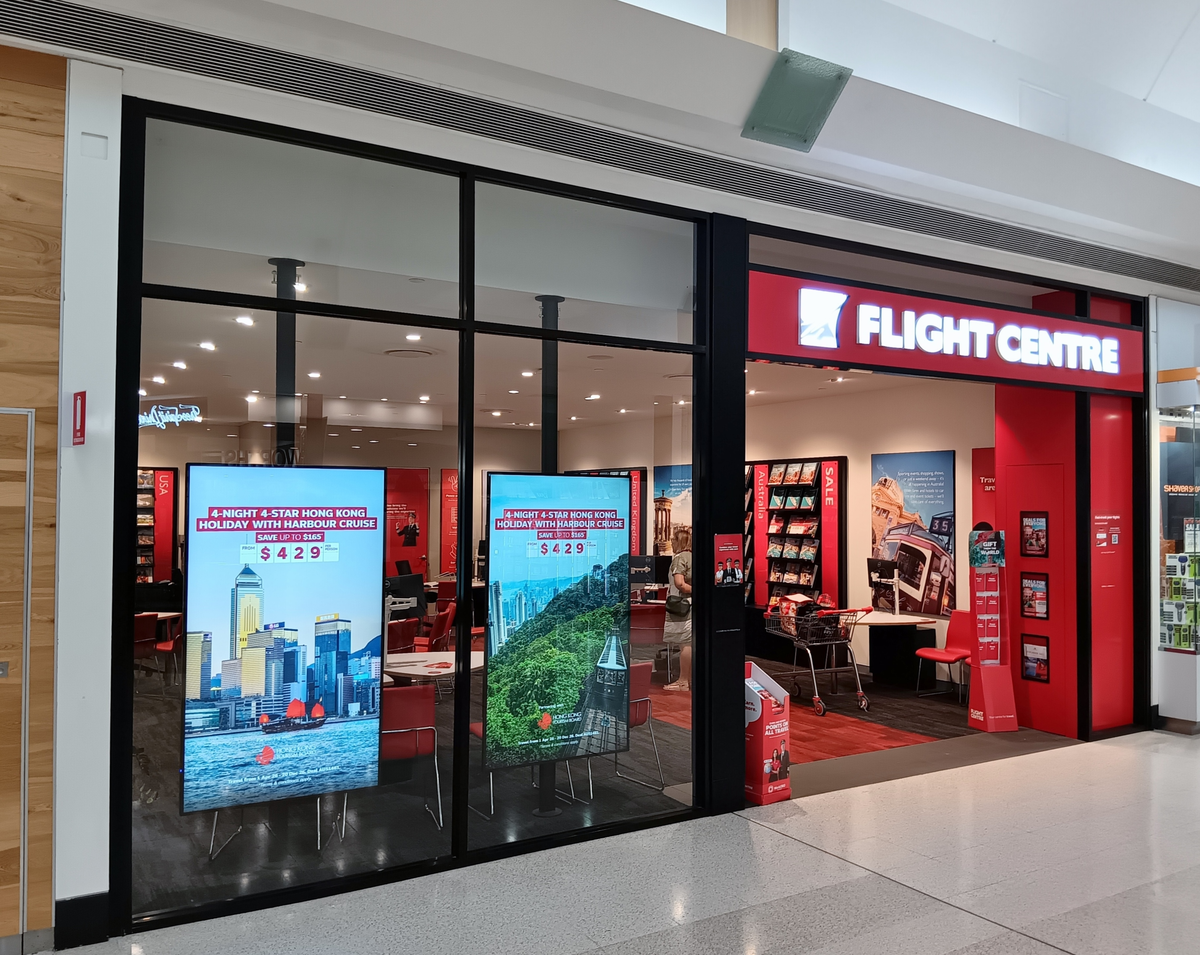
Photo: Flight Centre store at Westfield Booragoon (Garden City), Perth, by Bahnfrend via Wikimedia Commons, CC BY-SA 4.0 (resized).