After more than a decade of talks, the countries that make up the United Nations weapons treaty known as the CCW have agreed to keep working on rules for lethal autonomous weapons, the systems often called “killer robots”. But they did not agree to negotiate a binding treaty. The deal, reached in Geneva after an all-night session that ended in the early hours of Saturday 21 November (Saturday afternoon in eastern Australia), gives a group of experts two years to “elaborate” an instrument whose legal force is still undecided. Here is what was agreed, why it fell short of what most countries wanted, and what it means for Australia.
What happened in Geneva
The Seventh Review Conference of the Convention on Certain Conventional Weapons ran at the Palais des Nations from 16 to 20 November, chaired by Swiss ambassador Julien Thöni, according to the UN Office at Geneva. Review conferences happen every five years, and this one was expected to decide what comes after the CCW expert group’s 2024–2026 work. That group adopted a final report on 4 September containing “a set of elements of an instrument, without prejudging its nature.”
The talks ran past their scheduled end. Reuters, in a report published by CNBC, said the meeting concluded after 4am (0300 GMT) on Saturday, about 2pm AEDT. Politico reports that Thöni told reporters the 128 member countries had agreed to launch “the elaboration of an international instrument on lethal autonomous weapons systems” over the next two years, with an expert group reporting to a 2028 meeting of the treaty’s parties.
Thöni hailed the deal as a significant achievement for humanitarian disarmament, Reuters reported. “It shows that even in today’s deeply divided world, multilateral diplomacy can still deliver concrete results,” he told reporters. Most humanitarian groups saw it very differently.
Why “elaborate” matters more than it sounds
The fight was over a single verb. A mandate proposal posted on the UN disarmament office’s conference page would have had the expert group “negotiate a new Protocol to the Convention” and submit a draft protocol in 2028. The final text, as reported by the Guardian and Politico, instead asks countries “to elaborate by consensus” an instrument. Digital Watch, which tracked the conference, notes that this “leaves open whether the next phase will produce new legal obligations or non-binding guidance.” The final adopted decision had not been published on the UNODA page when we checked on Sunday evening, so we are relying on these reports for its wording.
The CCW works by consensus, so all 128 parties must agree. That gave any single country an effective veto. The Guardian reports that more than 100 states had pushed for a new law, and Reuters put the number backing binding rules on a short timeline at around 100. Even so, the mandate for a treaty did not survive.
Who blocked a binding treaty
Russia was the most visible obstacle. According to NPR, Russia delayed proceedings on day one by objecting to the agenda, and the United States then proposed “a five-year window to discuss nonbinding, optional guidelines for autonomous weapons.” Politico says Russia’s objections forced talks into informal sessions, and that two EU diplomats named the US, the UK, South Korea, Japan, Turkey and Israel as also resisting a binding regulation. A Brazilian diplomat told Politico: “You can blame Russia, but they are not the only ones. Some people are hiding behind Russia.”
On the other side, a bloc of seven countries, Austria, Belgium, Brazil, Ireland, Mexico, New Zealand and Panama, had pushed for a binding treaty to be negotiated within one year, the Guardian reports. New Zealand is the closest neighbour in that group.
What the Red Cross and campaigners said
The International Committee of the Red Cross said it “regrets” that the conference “failed to agree to a clear and immediate negotiation mandate for a legally binding instrument.” It wants a treaty that bans unpredictable autonomous weapons and those that target people directly, and restricts the rest. It pointed to a UN General Assembly First Committee resolution approved last month in which 163 states called for an instrument to be negotiated.
Campaigners were blunter. “Delaying the creation of a legally binding instrument puts civilians and humanity at risk,” said Nicole van Rooijen, executive director of the Stop Killer Robots coalition, as quoted by Reuters. Rain Liivoja, a director of the Asia-Pacific Institute for Law and Security, told Politico that with no mention of a binding instrument in the decision, “it remains possible — likely, even — that there will be no treaty by the end of 2028.”
Where Australia stands
Australia is one of the 128 CCW parties and has taken part in every CCW meeting on autonomous weapons since 2016, according to Automated Decision Research, a research site that tracks national positions on autonomous weapons. Its record is mixed. Australia voted for UN General Assembly resolution 80/57 on autonomous weapons in December 2025. At a 2023 expert meeting, it said it saw “broad support for a two-tier approach,” meaning some uses would be “inherently unlawful while others are subject to limits under international humanitarian law.” But in 2021 it said “we do not believe there is a need at this time for a new legal instrument,” and the monitor still lists Australia as not currently supporting negotiation of a binding treaty.
We could not find an official Australian Government statement on the final Geneva outcome, and much of the week’s work happened in informal sessions, so we cannot say what Canberra argued behind closed doors. One Australia-based expert quoted on the result is Liivoja, a professor at the University of Queensland Law School whose research focuses on the legal challenges of military uses of science and technology. If you want Australia’s current position on the record, the place to look is the government’s statements when the expert group resumes in 2027.
There is also a domestic link. Australia is already weighing tougher safety rules for frontier AI. The Geneva outcome is a reminder that rules for civilian AI and rules for AI in weapons are being set in very different rooms, at very different speeds.
What it means for the tech industry
For technology companies, the key word is still “optional”. The same advances in computer vision, sensors and onboard AI that power drones, robots and driver-assist systems are what make autonomous targeting possible. NPR notes that humans remain, “albeit very remotely,” in control of current semi-autonomous drones, but humanitarian groups fear weapons that make the final decision alone. Without a binding treaty, there is no shared international line for engineers, investors or export regulators to point to, only national rules and existing humanitarian law.
Our view (analysis)
This is not nothing. A two-year mandate keeps the issue inside a forum whose members include the US, Russia and China, and that matters, because a treaty without them would bind only the countries least likely to build these weapons. But the outcome is weaker than even its supporters hoped. It also shows the limit of consensus diplomacy: when one or two states can block everything, the result tends toward the lowest common denominator.
Watch three things. First, whether the expert group’s 2027 sessions agree that the instrument should be legally binding. Second, whether frustrated states take the issue outside the CCW, as happened with landmines and cluster munitions. Third, whether Australia moves from its cautious 2021 position toward the treaty camp, or stays with the larger military powers. On the evidence so far, that is still an open question.
What is confirmed and what is not
- Confirmed by multiple outlets: the CCW conference ended on 21 November Geneva time with a two-year mandate to “elaborate” an instrument on lethal autonomous weapons, reporting in 2028, without a commitment that it will be legally binding.
- Reported, not independently verified by us: the final decision’s exact wording (not yet published by UNODA), the number of states backing a binding treaty, and the list of countries said to have resisted it.
- Not known: Australia’s final stance at the conference, and whether a binding protocol will emerge by 2028.
Sources: UN Office at Geneva, UNODA conference documents, ICRC, Reuters via CNBC, Politico, The Guardian, NPR, Digital Watch, Automated Decision Research.
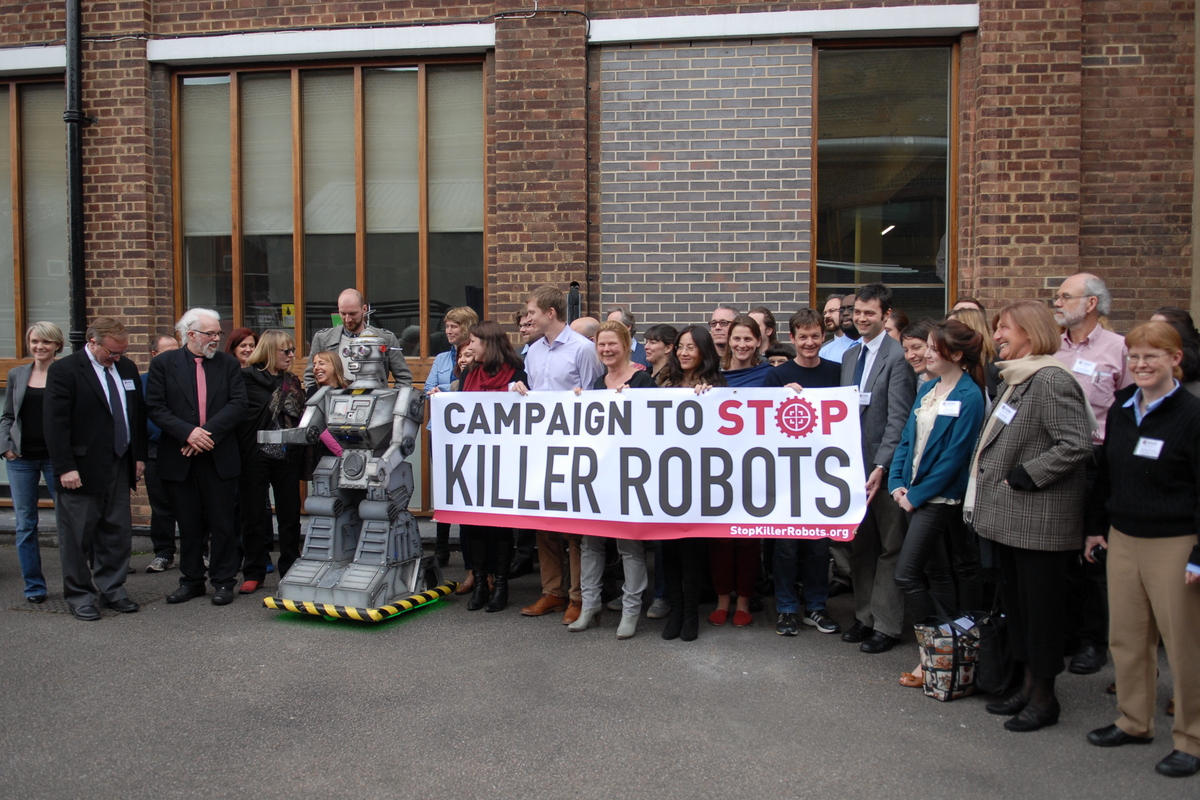
Photo: Campaign to Stop Killer Robots via Wikimedia Commons, CC BY 2.0 (cropped and resized). Archive photo from 2013.