SpaceX has caught the upper stage of its Starship rocket with its launch tower for the first time. Ship 42 came back from orbit and was grabbed by the tower’s mechanical “chopstick” arms at Starbase in Texas at about 8:20am AEDT on Sunday 15 November, roughly 22 and a half hours after it launched. No upper stage of an orbital rocket had been flown back to its launch site and caught like this before.
It was only half of what SpaceX wanted. The Super Heavy booster was meant to be caught too, a few minutes after launch, but it aborted and came down in the Gulf of Mexico. Still, getting the ship back in one piece is the harder part of making Starship fully reusable. Here’s what happened, what SpaceX says went wrong with the booster, and why it matters for Starlink users in Australia. (For the launch itself, see our Flight 15 launch report from Saturday.)
What happened on Flight 15
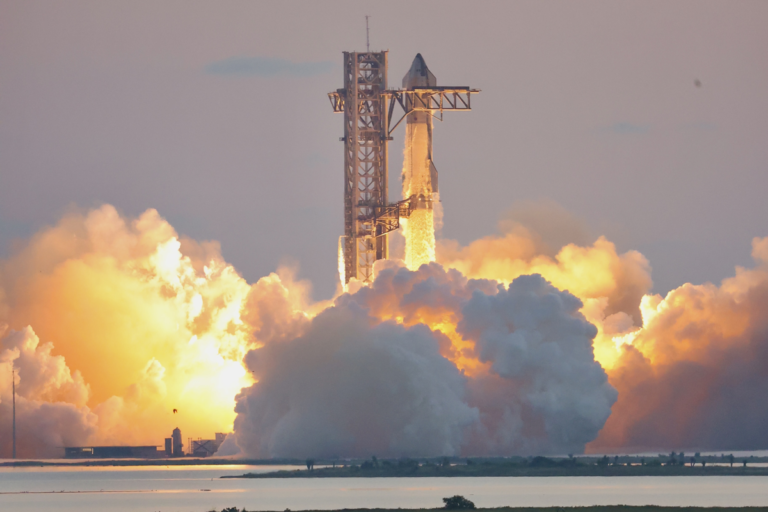
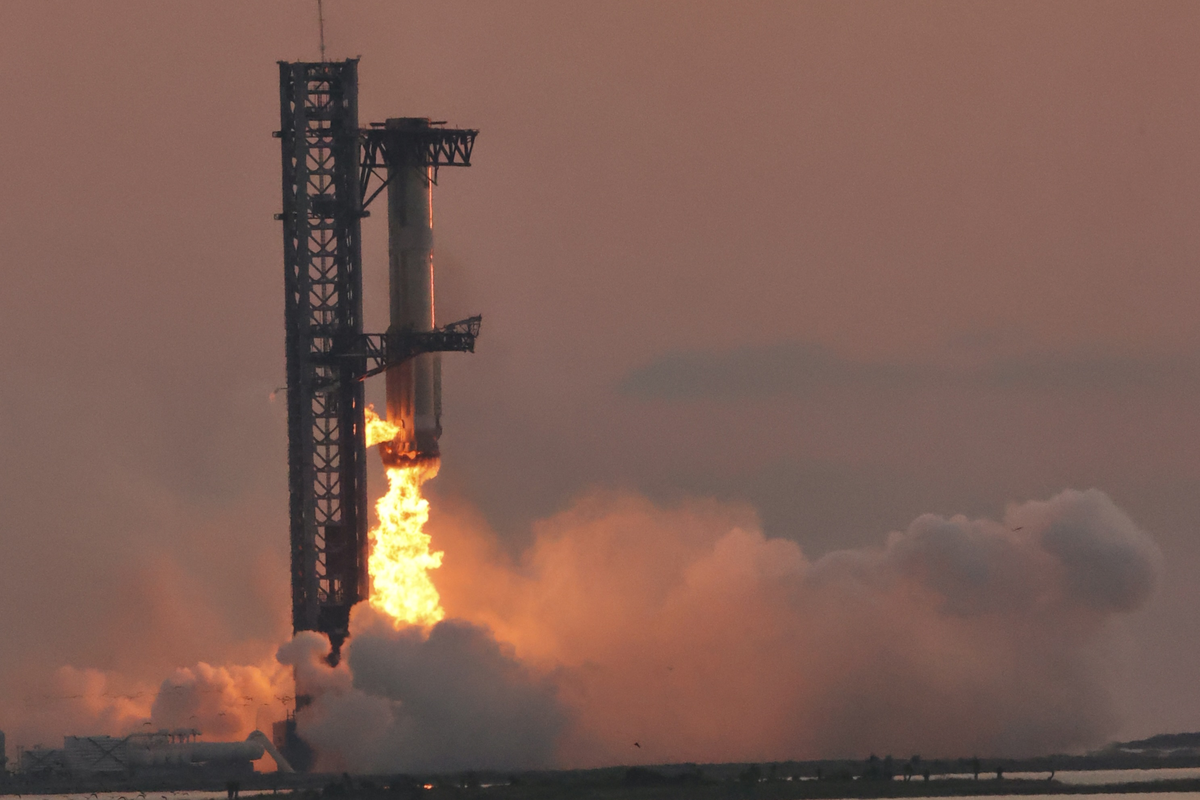
Starship lifted off from Starbase at about 4:47pm local time on Friday 13 November, which was about 9:47am AEDT on Saturday. According to Space.com and the BBC, the ship reached orbit, released all 26 of its Starlink V3 satellites and completed 14 orbits of Earth before coming home. SpaceX’s mission page said the ship would only try to return to the launch site if the flight team was sure that the systems needed for re-entry, the landing burn and the tower approach were healthy.
Those checks passed. Three of the satellites carried cameras to photograph the ship’s heatshield, and SpaceX said the imagery, along with other data, showed the vehicle was in good shape. The ship fired its engine to leave orbit, came back through the atmosphere, flipped upright and settled between the tower’s arms. Space.com puts the catch at 4:20pm US Eastern time (21:20 GMT) on Saturday, which was about 8:20am Sunday in Sydney, Melbourne, Canberra and Hobart.
SpaceX commentator Dan Huot didn’t hold back. “That was the missing link,” he said on the company’s webcast, as quoted by Space.com. “That was the holy grail of spaceflight, plummeting through fire to be snatched out of the air by steel. We caught a Starship, and now everything changes.”
The booster that got away
Flight 15 was meant to be the first time SpaceX caught both stages of Starship on the same flight. That didn’t happen. On Friday, the Super Heavy booster aborted its catch, diverted offshore, hovered above the water and exploded, according to the BBC, the Associated Press and CNBC.
SpaceX’s Kate Tice gave an early explanation during Saturday’s webcast, reported in Space.com’s live coverage: “Early indications are that the booster ended its boostback [burn] early due to a low fuel mass alarm.” She added: “The team is still investigating the root cause on that.” Elon Musk wrote on X that the booster was “slightly low on fuel”, the BBC reported. According to Teslarati, Musk said the fix involves more consistent engine performance and a software change to cut the engines “about one second earlier”, and that the loss does not change SpaceX’s timeline. Those are SpaceX’s early explanations, not the findings of a completed investigation.
Why catching the ship is the hard part
SpaceX has now caught a Super Heavy booster three times on earlier flights. The ship is much harder. It travels higher and faster, and it has to survive re-entry from orbit before it can attempt a precise landing next to the tower. Until now, every Starship upper stage that flew ended up in the ocean or was lost.
Recovering both stages matters because it is the whole reason Starship exists. If both parts can be caught, inspected and flown again quickly, the cost of each launch should fall sharply, in the same way reusable Falcon 9 boosters changed launch prices. SpaceX hasn’t shown that yet. It has caught the two halves on different flights, but not both on the same mission, and it hasn’t refurbished and reflown a ship.
Prof Malcolm Macdonald, president of the Royal Aeronautical Society, summed it up for the BBC: “They have demonstrated the two halves of the recovery challenge, just not yet on the same flight. The next milestone would be stitching those achievements together and then proving they can do it reliably, repeatedly and economically.”
What SpaceX says comes next
These are company claims and plans, not things that have happened:
- SpaceX says each Starlink V3 satellite adds 1 terabit per second of capacity, and that the 26 launched on this flight equal about 10 Falcon 9 launches of the older V2 Mini satellites. It says they should begin serving customers “as soon as a few weeks after launch” (SpaceX). These capacity figures haven’t been independently verified.
- One Starship can carry up to 60 Starlink V3 satellites, according to SpaceX via CNBC. The existing constellation already has more than 11,000 satellites in low Earth orbit.
- Musk has said he expects Starship to reach a weekly launch rate in the first half of 2027 (Teslarati). Before this flight, he called a successful ship catch “more likely than not” (The Verge). SpaceX’s timelines have often slipped.
- The AP reports SpaceX expects to begin launching Starships from Florida within the next few months. NASA is relying on Starship as a Moon lander for its Artemis program.
What it means for Australia
Starlink is now a significant part of Australian broadband. In a June 2026 speech, ACCC Commissioner Anna Brakey said Starlink’s retail subscribers grew from 375,000 in June 2025 to 552,000 in December 2025. “Starlink is now the second largest network providing services in Australia after NBN,” she said. She also noted that NBN Co has a wholesale satellite deal with Amazon to eventually move users off its Sky Muster service, so low Earth orbit internet is becoming a real contest here.
Starship is how SpaceX plans to launch its much bigger V3 satellites in large numbers. A reusable ship should mean more launches, more often, for less money. Over time, that could mean more network capacity for Australian Starlink users as subscriber numbers keep growing. But nothing about this catch changes your Starlink plan, price, dish or speeds today. SpaceX hasn’t said how much new V3 capacity will cover Australia, or when.
If you want the bigger picture, our earlier piece on the reusable rocket revolution and Australia’s space ambitions explains why recovering and reflying rockets matters so much for the whole launch industry, and where Australia fits in.
Our read
Our read: This is a genuine engineering first, and it’s fair to call it a big moment for reusable rockets. But one catch isn’t a reusable rocket system. The booster loss shows SpaceX still has reliability problems to solve, and the real test is whether it can catch both stages on the same flight, turn a ship around and fly it again without months of repairs. For Australians, the milestone to watch is quieter: whether the V3 satellites start carrying traffic within the weeks SpaceX has promised, and whether Starlink’s capacity here grows as quickly as its subscriber numbers.
Featured image: a Super Heavy booster being caught by the launch tower’s arms during Starship’s fifth flight test at Starbase, Texas, in October 2024 (not Flight 15 and not the ship catch; not supplied by SpaceX). Photo: Steve Jurvetson, via Wikimedia Commons, CC BY 2.0; cropped, resized and converted to PNG.