United Launch Alliance’s Vulcan rocket failed on its way to orbit early this morning Australian time, destroying all 40 Amazon Leo broadband satellites on board. The rocket lifted off from Cape Canaveral in Florida at 12:40pm US Eastern time on Sunday (4:40am AEDT Monday), and about 50 minutes later ULA confirmed that the vehicle “suffered an anomaly 10 minutes into the flight and failed to deliver the Amazon mission to orbit.”
It is a long way from Australia, but it matters here. Amazon Leo is the satellite network NBN Co has chosen to replace Sky Muster for regional and remote homes and businesses, and that plan depends on Amazon getting enough satellites into orbit. Here’s what happened, what we know and don’t know, and what it could mean for the NBN’s low Earth orbit service.
What happened on the launch
The mission, which Amazon calls LV-01 (Leo Vulcan 1), was the first of 38 Vulcan launches Amazon has booked with ULA. It was the first Vulcan to fly with six strap-on solid rocket boosters, and the debut of a new, shorter Centaur V upper stage optimised for low Earth orbit. ULA had billed it as a company-record payload of more than 22,700 kg, and it lifted off after two days of delays and a late hold in Sunday’s countdown.
According to Spaceflight Now, it was the first outright mission failure for ULA since the Boeing and Lockheed Martin joint venture was formed in 2006, and only the fifth Vulcan flight. It was also Vulcan’s first launch in nine months: the rocket had been sidelined after a solid booster nozzle problem on a US national security launch in February, which ULA said it had fixed with changes to the nozzle design.
ULA says it doesn’t yet know what went wrong. Its statement said the company would work with its customer “to find the cause, determine the appropriate corrective action and return to flight as quickly as possible.”
What we know about the cause, and what we don’t
This is where early reporting differs, so it’s worth being careful. The solid boosters appear to have worked normally this time. Both Spaceflight Now and Ars Technica report that Vulcan’s first stage, powered by two Blue Origin BE-4 engines, appeared to fire longer than ULA’s pre-launch timeline called for.
From there the accounts diverge. Spaceflight Now read ULA’s update as placing the problem during the burn of the Centaur upper stage, and said telemetry-driven animation showed Centaur making unusual orientation adjustments early in that burn. Ars Technica, citing multiple unnamed sources, reported the anomaly occurred in the booster stage rather than Centaur or the solid boosters. ULA itself has not identified a cause. Its investigations into Vulcan’s earlier booster problems took months.
The BE-4 question matters beyond Vulcan. Blue Origin’s New Glenn rocket, which uses a version of the same engine and also has Amazon Leo launches booked, has been grounded since a ground-test explosion in May that was traced to a valve in a BE-4. Spaceflight Now reports the engines on Sunday’s Vulcan had been retrofitted with Blue Origin’s fix. If the BE-4 turns out to be involved, both rockets could face longer delays; if it isn’t, New Glenn may be less affected. Right now nobody outside the investigation knows.
Why it’s a big setback for Amazon Leo
Losing 40 satellites hurts, but the bigger problem is losing the rocket. Before Sunday, Amazon had launched 396 Leo satellites on 14 missions since April 2025, GeekWire reports, a small fraction of the more than 3,200 first-generation satellites it plans. Vulcan was meant to be the workhorse: GeekWire says it is slated to carry more than 1,500 of them, more than any other rocket in the program, and Amazon had said a second Vulcan mission could follow within weeks. That now has to wait for ULA’s investigation.
Amazon is putting on a brave face. In a statement on its mission updates page, it said: “There is risk with any launch, and that’s especially true for inaugural missions like LV-01. ULA has been a trusted partner for Amazon, and we believe they’ll learn from this mission and deliver on their long-term plans for Vulcan.” Its next listed mission is unaffected for now: an Arianespace Ariane 6 launch of 36 satellites, scheduled for no earlier than 23 November.
Amazon’s other options are limited. Ars Technica expects Amazon will have to lean on the 10 launches it still has booked on SpaceX’s Falcon 9, operated by its main satellite broadband rival, and on Ariane 6 in the coming months. Amazon had said it planned to begin an initial rollout of commercial service by the end of this year.
What it could mean for NBN’s Sky Muster replacement
In August, NBN Co said eligible customers could “generally expect to begin transitioning to nbn LEO from around mid-2027”, subject to final testing and readiness, with the rollout happening progressively “as capacity becomes available.” It planned to begin testing later this year, followed by customer trials. That mid-2027 date was already a delay: WhistleOut reported the service had originally been slated for the fourth quarter of this year, and understood the slip was at least partly because Amazon was running behind.
What NBN has announced for the service so far:
- Who it’s for: homes and businesses in the NBN satellite footprint, currently served by Sky Muster and Sky Muster Plus.
- Plans: uncapped data with wholesale speed tiers of up to 50/10 Mbps and up to 100/20 Mbps, bought through participating Australian internet providers.
- Equipment: a standard professional installation and equipment package, including a Wi-Fi router, at no upfront wholesale charge, with a self-install option.
- The big gain: lower latency and better upload performance than Sky Muster, whose satellites sit about 36,000 km up. NBN executive Gavin Williams told Farm Online the lower orbit would cut latency from about 600 milliseconds to about 60.
- Continuity: NBN says existing Sky Muster services are generally expected to keep operating while customers move across.
Farm Online reported in August that about 300,000 premises sit in the satellite footprint and about 60,000 current Sky Muster customers would move to the Amazon-run network, with migration starting in Tasmania and working north. It also reported that Amazon needed at least 600 satellites in orbit to start its Australian operation. If that figure still holds, Amazon was about 200 short before Sunday, and Vulcan was supposed to close much of that gap.
NBN Co hadn’t publicly commented on the Vulcan failure when we checked this morning, and it hasn’t changed its mid-2027 target. A single failed launch doesn’t automatically push the date back. But a long Vulcan grounding, especially combined with New Glenn’s problems, would make that date harder to hit.
What Sky Muster users should do now
Nothing urgent. Your current service isn’t affected by this, and NBN has said Sky Muster will keep running through the transition. If you’re weighing up whether to wait for NBN’s low Earth orbit service or switch to an alternative now, the realistic read is that the wait may be longer than the official date suggests, and that’s worth factoring in.
The alternative most people will look at is Starlink, which has grown quickly in Australia. We covered what SpaceX’s latest Starship flight and Starlink V3 satellites mean for Australian users and the first Starship upper-stage catch over the weekend. Note that Starlink is a direct retail service with its own hardware and pricing, not an NBN product.
Our read
Sunday’s failure shows how much of the low Earth orbit broadband race comes down to launch capacity rather than satellites. Amazon says it has built a large production line, but satellites in storage don’t connect anyone. SpaceX can launch its own; Amazon depends on partners, and two of its three big new rockets are now grounded at once.
For regional Australians, the useful takeaway is that NBN’s Amazon-powered upgrade remains a plan with a date attached, not a service you can count on yet. Watch for ULA’s first findings on the cause, the Ariane 6 launch later this month, and any update from NBN Co on testing and trials.
Sources: United Launch Alliance mission page and pre-launch briefing; Amazon Leo mission updates (updated 15 November 2026, US time); NBN Co (27 August 2026); reporting by Spaceflight Now, Ars Technica, GeekWire, WhistleOut and Farm Online. Times converted to AEDT.
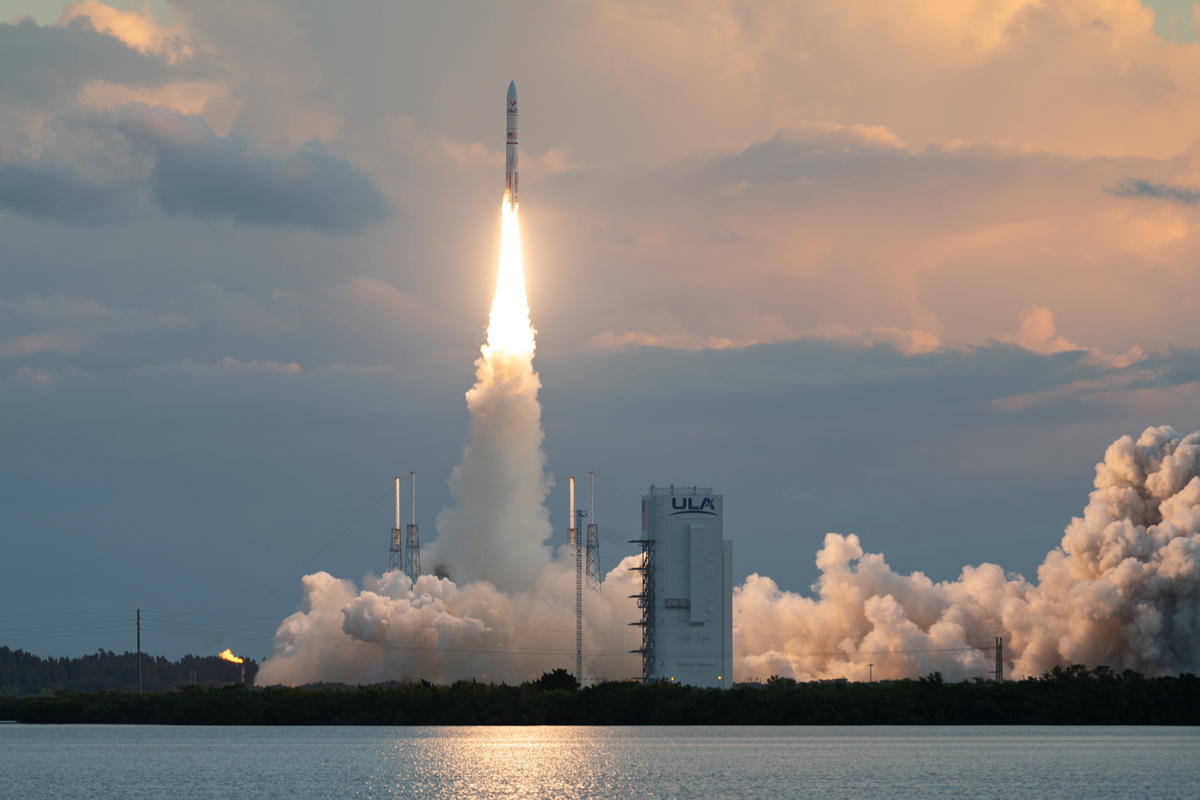
Featured image: a United Launch Alliance Vulcan rocket lifts off on its second certification flight from Cape Canaveral Space Force Station, Florida, 4 October 2024. This is not the 15 November 2026 launch. Photo: U.S. Space Force / Airman 1st Class Collin Wesson, via Wikimedia Commons (public domain, US government work); cropped slightly to 3:2, resized and converted to PNG. Use does not imply endorsement by the U.S. Space Force.