OpenAI has quietly made one of its most consequential healthcare moves yet: ChatGPT for Clinicians is now free for verified U.S. clinicians.
The headline feature is access to a clinician-focused ChatGPT workspace with higher limits on GPT-6, OpenAI’s most capable model family for healthcare tasks. But the more important story is not the model name. It is the fact that OpenAI is removing the subscription barrier for a professional tool designed to sit much closer to real clinical work.
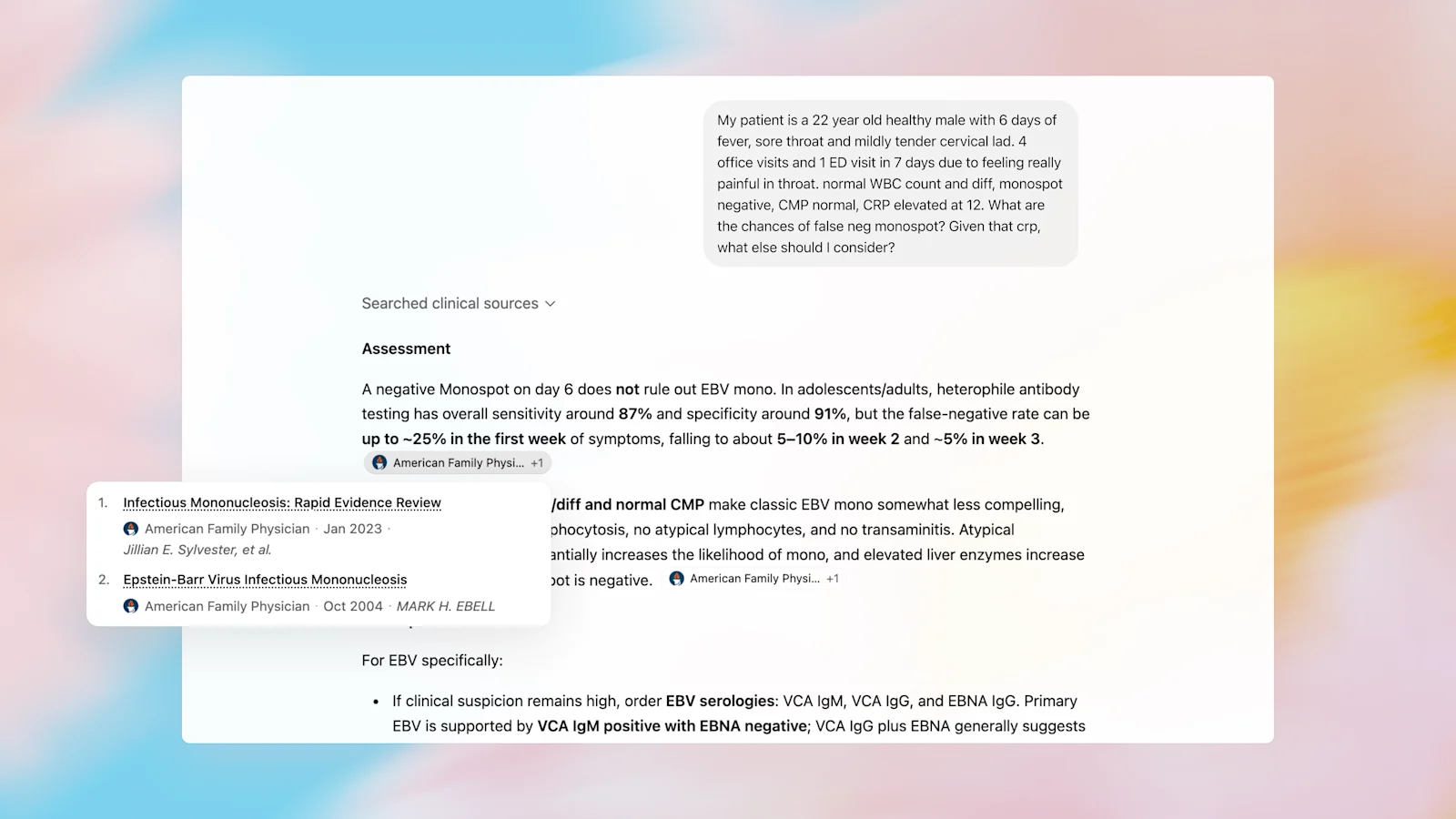
For doctors, nurse practitioners, physician assistants, psychologists and other eligible licensed clinicians in the United States, the service combines trusted clinical search, citations, reusable workflows, medical literature research and support for earning CME credits. Verification is handled using a clinician’s NPI during signup.
What OpenAI is actually offering clinicians
ChatGPT for Clinicians is positioned as a separate professional workspace rather than simply another consumer ChatGPT tier. OpenAI says it is intended to help with evidence review, clinical reasoning, documentation drafting and patient education while keeping the clinician responsible for the final decision.
One of the most useful changes is the emphasis on cited medical answers. OpenAI says clinical search can draw from millions of peer-reviewed studies, public-health guidance and clinical guidelines, with responses showing source details such as journal names and publication dates.
The platform also includes deep research across medical literature, reusable skills for recurring workflows such as referral letters and patient instructions, and CME support for eligible clinical questions.
That makes this less like a general chatbot with a medical prompt and more like an attempt to build an AI workbench for individual clinicians.
Why the free price matters more than it first appears
Healthcare has no shortage of AI pilots. What it often lacks is frictionless access.
Many clinicians work in hospitals or practices where enterprise AI adoption moves slowly because of procurement, governance, privacy reviews and integration requirements. OpenAI is effectively taking a different route here: give individual verified clinicians access directly, even if their employer has not yet deployed an organization-wide AI platform.
That matters because habits form before procurement cycles finish.
If clinicians begin using AI routinely for literature review, documentation support, patient-facing explanations and differential thinking, those workflows may become expected parts of clinical practice long before every health system has settled on its preferred enterprise vendor.
In other words, the most important feature may be the price: free removes one of the easiest reasons not to try it.
GPT-6 could push clinical AI beyond simple summarisation
OpenAI says the clinician plan comes with higher GPT-6 limits for complex questions, research and documentation. That is significant because many of the highest-value healthcare tasks are not one-shot questions.
A meaningful clinical workflow may involve comparing guidelines, assessing contraindications, reviewing current evidence, drafting a referral or patient handout, and then revising the result around a specific case. More capable models matter most when the task has several linked steps and the user expects the system to keep context straight.
That does not make the AI the decision-maker. OpenAI explicitly states that ChatGPT for Clinicians is intended to support professional judgment, not replace it, and clinicians remain responsible for independently verifying information where appropriate.
Privacy will be the test clinicians care about
OpenAI says content shared in ChatGPT for Clinicians is not used to train its models. The company also says HIPAA support is available where a clinician is authorized to sign a Business Associate Agreement.
That distinction is important. A tool can be medically capable and still fail in healthcare if clinicians are uncertain about where patient information goes, how it is retained or what their organization permits them to enter.
For many everyday uses, clinicians may not need to enter protected health information at all. But the closer these systems move toward chart summaries, documentation and case-specific reasoning, the more governance will matter.
This is also a competitive move
The healthcare AI market is increasingly crowded, spanning clinical reference tools, documentation assistants, enterprise copilots and specialist medical models. OpenAI’s advantage here is simple: many clinicians already know how to use ChatGPT.
By pairing that familiarity with verified clinician access, medical citations and a zero-dollar individual plan, OpenAI is making a strong bid to become the default AI layer clinicians reach for before their workplace has made a formal platform decision.
That could be more strategically important than any single benchmark.
What it means for clinicians outside the US
For now, this is a U.S.-only offer. OpenAI says it plans to expand ChatGPT for Clinicians to additional countries over time, but it has not announced a broader rollout timetable.
That leaves clinicians in markets such as Australia watching from the sidelines for now. If the U.S. rollout proves popular, international expansion could become one of the more important next steps in professional AI adoption.
The Tech Boom view
There will be plenty of debate about whether AI belongs in the clinical workflow. In practice, that debate is already being overtaken by a more useful question: under what rules, with what evidence and with what level of human oversight?
OpenAI’s free clinician plan does not solve those questions. But it makes them much more immediate.
When powerful medical AI is no longer locked behind a specialist enterprise contract or a monthly consumer subscription, adoption can move quickly. The winners will not necessarily be the systems that sound the smartest. They will be the ones clinicians can verify, trust, govern and fit into real work without losing control of the decision.
ChatGPT for Clinicians is OpenAI’s clearest attempt yet to compete on exactly those terms.
Source: OpenAI’s ChatGPT for Clinicians product page and OpenAI release notes. This article is editorial analysis and does not constitute medical advice.