Editorial analysis
Apple has finally joined the foldable phone market. But it may only be halfway there.
The iPhone Duo gives Apple a direct answer to Samsung’s Galaxy Z Fold family: a conventional-looking phone on the outside that opens into a much larger display for video, gaming and multitasking.
What Apple still doesn’t have is an answer to the other half of Samsung’s foldable strategy — the Galaxy Z Flip.
And that makes an old Apple experiment suddenly much more interesting.
Earlier this year, Bloomberg’s Mark Gurman reported that Apple was exploring a square, clamshell-style foldable iPhone. Separate supply-chain reporting later claimed Apple had tested flip-style hardware. The device has never been announced, and subsequent reporting has cast doubt on whether Apple believes the form factor creates enough new value to justify shipping it.
But now that the iPhone Duo is real, the question has changed.
Apple no longer has to decide whether the iPhone should fold.
It has to decide how many different reasons an iPhone should have to fold.
The iPhone Duo isn’t really Apple’s Galaxy Z Flip rival
Apple’s first foldable is unmistakably a book-style device.
The iPhone Duo has a 5.4-inch outer display and opens to a 7.6-inch folding Super Retina XDR display. Apple pitches that larger canvas around content, gaming, multitasking and new iOS experiences that respond to the device’s different positions.
Australian pre-orders open at 11:00 pm AEDT on October 16, with availability beginning October 23. Prices start at A$3,499 for 256GB and climb as high as A$5,899 for the 2TB model.
We have a full Australian iPhone Duo price and release guide here, and we’re also tracking Australian carrier pre-order offers ahead of launch.
Samsung’s Galaxy Z Flip8 solves a very different problem.
Instead of turning a phone into something closer to a small tablet, the Flip takes a full-sized smartphone and folds it down into a much smaller shape for carrying.
That distinction matters because Samsung isn’t really selling one foldable idea anymore.
It’s selling two.
The Fold makes your phone bigger when you need more screen. The Flip makes your phone smaller when you don’t.
Apple currently offers only the first proposition.
Apple really has explored an ‘iPhone Flip’
The idea isn’t based solely on fan-made renders.
In February, Bloomberg’s Mark Gurman reported that Apple had a square, clamshell-style foldable phone under consideration in its labs. Gurman cautioned that the product was far from guaranteed to reach the market.
Later that month, a separate supply-chain claim reported by MacRumors said Apple had tested a flip-style foldable iPhone, although whether it would proceed to mass production had not been decided.
Then came a conflicting report in March: Apple had considered a clamshell design but may have shelved it because simply making an iPhone smaller when folded wasn’t seen as a compelling enough new use case. The same report pointed to internal-space compromises around battery and camera hardware.
None of those reports amount to an Apple product announcement.
There is currently no confirmed iPhone Flip, no release date and no official price.
But taken together, they tell us something useful: Apple has at least seriously examined the same form factor Samsung has spent years refining.
Samsung has already shown why two foldables can coexist
Australia provides a particularly useful comparison.
Samsung’s current Galaxy Z8 family spans both sides of the foldable market. The Galaxy Z Fold8 starts at A$2,699, while the Galaxy Z Fold8 Ultra starts at A$2,999.
The Galaxy Z Flip8 starts at A$1,949.
Apple’s iPhone Duo starts at A$3,499.
That’s a A$1,550 gap between the cheapest current Samsung clamshell and Apple’s first foldable.
An Apple clamshell wouldn’t automatically be cheap. Flexible displays, hinges, compact component layouts and Apple’s premium positioning make that unlikely.
But a smaller foldable potentially gives Apple a route to a more accessible foldable iPhone than the Duo.
That could ultimately matter more to mainstream adoption than another ultra-premium book-style device.
An iPhone Flip would need a reason to exist
This is where Apple’s hesitation makes sense.
A clamshell phone sounds simple: take an iPhone, put a hinge through the middle and let it fold into a square.
But Apple rarely enters a new hardware category simply because a competitor already sells one.
The company would need to answer a more difficult question:
What does an iPhone Flip let you do that an ordinary iPhone doesn’t?
Portability is the obvious answer, but it may not be enough.
A clamshell design also divides the internal space. The hinge competes with batteries, cameras, cooling and other components. Making the phone thinner and smaller when folded can mean accepting compromises elsewhere.
Apple has already learned that “smaller iPhone” doesn’t automatically mean bigger demand. The iPhone mini line disappeared after only a short run.
A successful iPhone Flip therefore needs to be more than the spiritual successor to the iPhone mini with a hinge.
The iPhone Duo may have already solved part of that problem
The most important thing about the Duo isn’t simply that its OLED panel bends.
Apple has redesigned parts of the iPhone experience around a device that changes shape.
The Duo supports different poses and orientations. Apps can use its larger internal canvas for multitasking. The device can stand on a surface. Its displays can create new camera and viewing experiences.
That software work creates a foundation Apple didn’t have when earlier clamshell prototypes were being considered.
A future iPhone Flip could use those ideas differently.
Fold it halfway and the upper display could become a camera viewfinder while controls occupy the lower portion. Place it on a table and it could become its own tripod for FaceTime or video. Close it and a cover display could surface Live Activities, widgets, notifications, music controls and Apple Intelligence without requiring the full phone to be opened.
That last point could be particularly important.
As voice and AI interfaces become more capable, a smaller external display becomes less restrictive. If Siri can complete more tasks conversationally, users don’t necessarily need to open a full app every time they want something done.
That could give an Apple clamshell a stronger reason to exist than it had several years ago.
Apple doesn’t need to copy the Galaxy Z Flip8
Apple would be arriving extraordinarily late to this category.
Samsung is already on the Galaxy Z Flip8. Motorola has spent years rebuilding the Razr around modern foldable displays. Chinese manufacturers have also pushed clamshell hardware aggressively.
Trying to win by simply producing an Apple-branded version of the same idea wouldn’t be particularly interesting.
But Apple now has something it didn’t have before September: an actual foldable iPhone platform.
The Duo answers one question:
What if your iPhone could become bigger when you needed it?
A clamshell could answer the opposite:
What if your iPhone could become smaller when you didn’t?
Those are different products for different buyers.
That is exactly how Samsung has built its foldable range.
The Australian price gap creates an opportunity
Price may ultimately be the strongest argument for a second foldable iPhone.
At A$3,499, the iPhone Duo sits well above even Apple’s conventional Pro models. It is a showcase device for buyers willing to pay a substantial premium for Apple’s first-generation foldable hardware.
A clamshell could potentially sit between a conventional flagship iPhone and the Duo.
That doesn’t mean Apple would match Samsung’s A$1,949 Flip8 price. There is no reported iPhone Flip price to compare.
But the shape gives Apple room to build a different product with a different cost structure and audience.
If the Duo succeeds, expanding downward may make more sense than immediately building an even more expensive foldable.
So will Apple actually release an iPhone Flip?
For now, the answer is possibly — but there is not enough evidence to call it an upcoming product.
Credible reporting says Apple has explored the clamshell concept. Other reporting says flip-style hardware has been tested. But there are also reports that Apple questioned the design’s usefulness and the compromises it would require.
Apple itself has announced nothing.
That distinction is important at a time when concept renders and speculative specifications can quickly turn an experimental device into a supposedly “confirmed” product online.
The next clue may not come from another leak at all.
It may come from the iPhone Duo.
If Apple’s A$3,499 foldable finds a meaningful audience after its October 23 release, Apple will have evidence that customers want more than one conventional slab-style iPhone.
At that point, different foldable shapes start to make considerably more sense.
The iPhone Duo may be the beginning, not the destination
For years, the question surrounding Apple was simple: when will it make a foldable iPhone?
That question is now obsolete.
The iPhone Duo exists. Apple has committed its hardware, software and developer ecosystem to a folding iPhone.
The more interesting question is what Apple does with that foundation next.
Samsung’s answer has been to make foldables a family: large-screen Fold models for people who want more display, and compact Flip models for people who want less phone in their pocket.
Apple may eventually reach the same conclusion.
And if it does, Samsung’s Galaxy Z Flip won’t simply have another Android rival.
It will finally have an iPhone aimed directly at the reason the Flip exists.
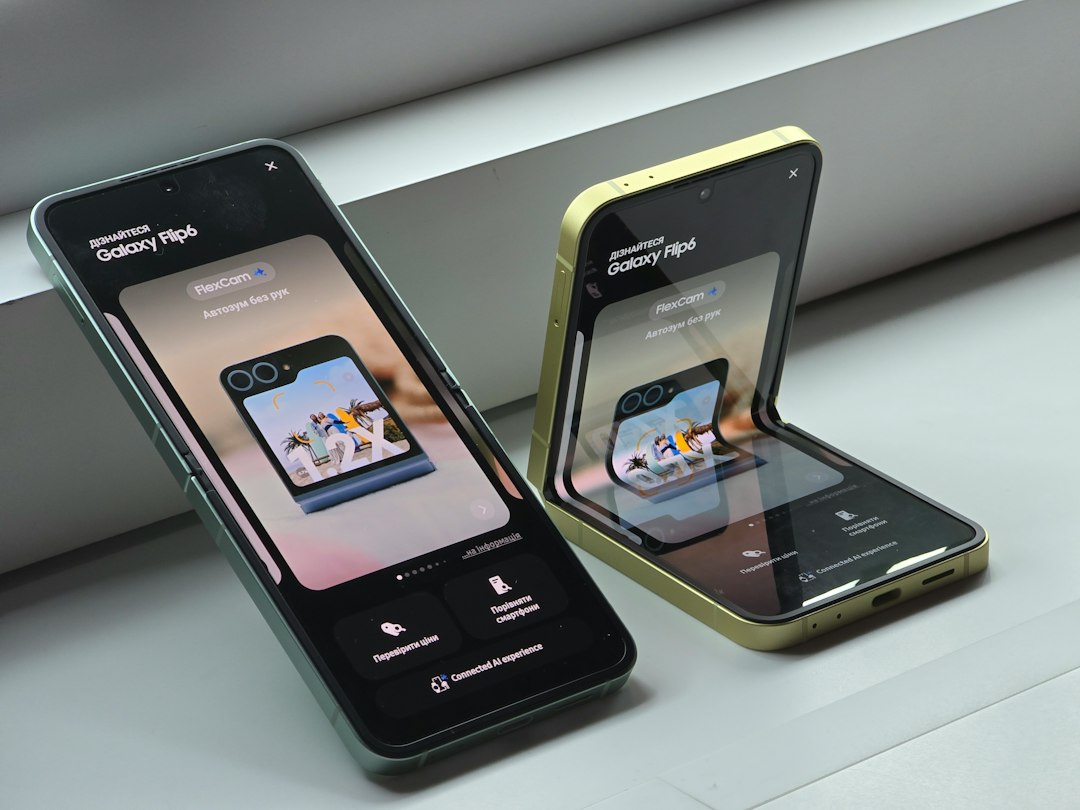
Sources: Apple Australia and Apple Newsroom for official iPhone Duo specifications, Australian pricing and availability; Samsung Newsroom Australia for Galaxy Z8 Australian pricing; Bloomberg reporting as subsequently reported by MacRumors and 9to5Mac regarding Apple’s exploration of a clamshell-style foldable. Apple has not announced an iPhone Flip. Featured image: Evgeny Opanasenko / Unsplash, showing a Samsung Galaxy Z Flip device for illustration.