An experimental open-source project called AnyPS5 is attracting attention after reporting major progress in converting PlayStation 5 games to run on Windows and Linux. But despite the impressive technical milestone, playing the latest PS5 exclusives on PC remains a much bigger challenge.
A new project in the PlayStation gaming community is generating excitement over the possibility of running PlayStation 5 games directly on a PC without relying on traditional console emulation.
Known as AnyPS5, the open-source tool aims to convert PS5 game executables into native Windows and Linux applications.
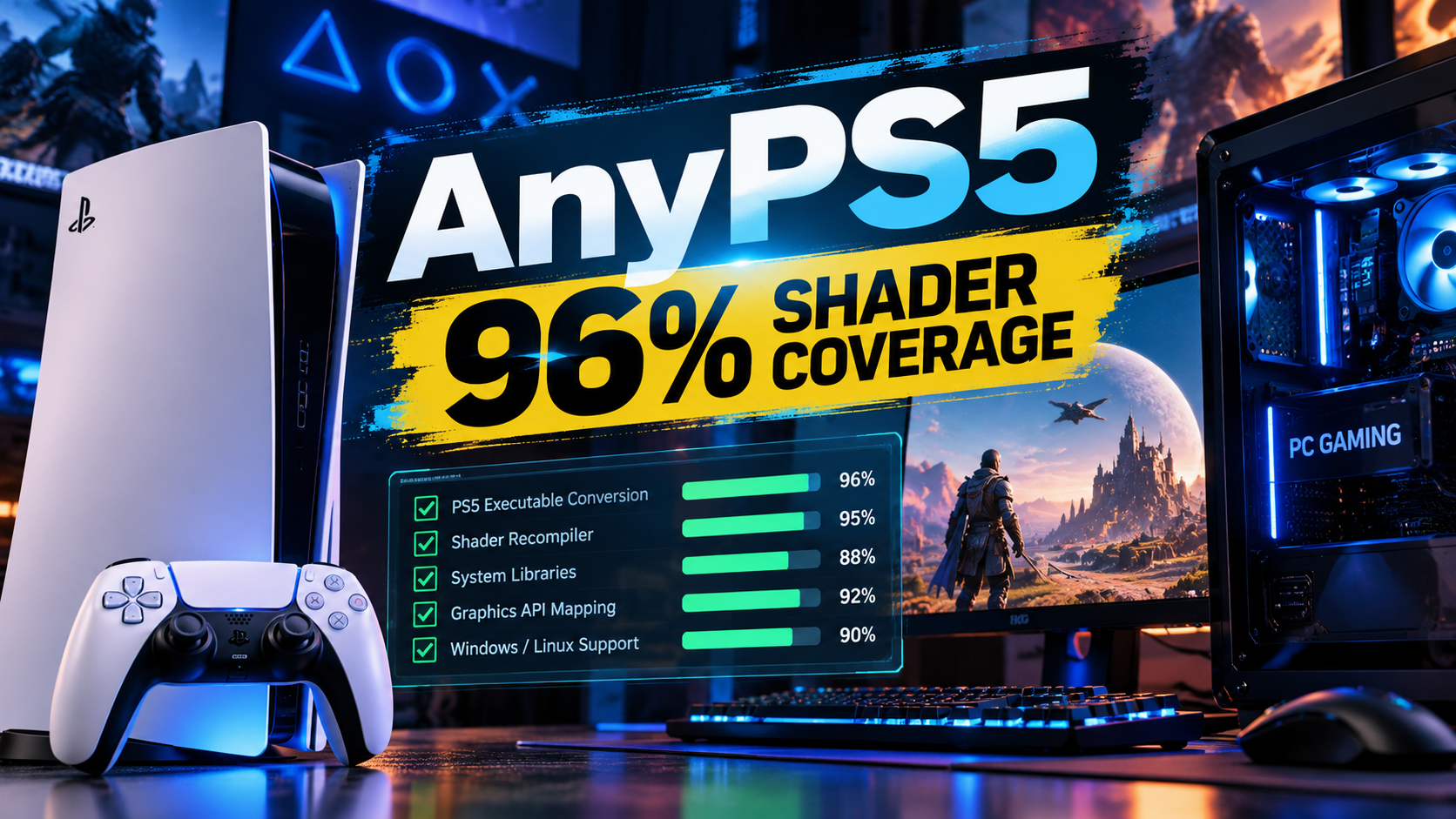
The project has recently attracted attention after reports indicated its shader recompiler had reached approximately 96% coverage of the PS5 GPU instructions currently tracked by its developers.
For PC gamers, that sounds like a major breakthrough.
However, the figure does not mean that 96% of PlayStation 5 games are compatible with the software. It represents progress in one technical component of a much larger compatibility challenge.
With interest in AnyPS5 growing, here’s what the project actually does, how it differs from PS5 emulation and what its development could mean for the future of PC gaming.
What Is AnyPS5?
AnyPS5 is an experimental open-source project designed to convert PlayStation 5 executable files into programs that can run on Windows and Linux.
Unlike a traditional console emulator, which attempts to reproduce the hardware and software environment of a gaming console, AnyPS5 takes a different approach.
Its developers describe the technology as an automatic executable porting system.
The software uses a component called a relinker to convert a PS5 executable into a format recognised by the target operating system.
It also provides replacement implementations of PlayStation system libraries, allowing converted applications to access functions they would normally expect from the console.
This approach is possible partly because the PlayStation 5 uses an AMD processor based on the x86-64 architecture, which is also widely used in modern gaming PCs.
However, sharing a processor architecture does not eliminate the differences between a console and a desktop computer.
Graphics processing, system libraries, memory management and other console-specific functions still require substantial work.
AnyPS5 Reaches Nearly 96% Shader Instruction Coverage
One of the most significant developments involves AnyPS5’s shader recompiler.
According to reporting published on 6 October 2026, the project had implemented support for 1,118 of 1,166 tracked GPU shader instructions, representing approximately 95.88% coverage.
Earlier reported figures showed support for 609 instructions, or around 52.23%.
The increase represents substantial progress in the project’s ability to translate PlayStation graphics instructions into a form usable by PC graphics systems.
AnyPS5 uses a shader recompilation process that generates SPIR-V, an intermediate format commonly associated with Vulkan graphics applications.
This allows supported graphics instructions to be translated for execution through compatible PC graphics hardware.
However, there is an important distinction between shader coverage and actual game compatibility.
A game may rely on thousands of interactions involving graphics, audio, storage, memory and operating-system functions.
Even if its shader instructions are supported, missing system functionality can prevent the game from launching or running correctly.
Reaching 96% shader instruction coverage is therefore an engineering milestone, not evidence that most PS5 games are ready to play.
Has AnyPS5 Successfully Run a PlayStation 5 Game?
The project has documented a working result involving Dreaming Sarah, a relatively lightweight 2D platform game.
According to the AnyPS5 project documentation, the game runs at a stable 60 frames per second on a PC equipped with an Nvidia GeForce GTX 1050 Ti graphics card and an Intel Core i5-7500 processor.
This is an encouraging early result because it demonstrates that the project’s executable conversion approach can work with at least some real game software.
However, Dreaming Sarah is considerably less demanding than modern blockbuster PlayStation 5 releases.
A successful result with a 2D game does not demonstrate that graphically intensive titles will work at comparable performance levels.
Compatibility will need to be assessed individually as the developers implement more system functions and improve graphics support.
For now, AnyPS5 remains an experimental project rather than a practical replacement for owning a PlayStation 5.
How Is AnyPS5 Different From a PS5 Emulator?
Traditional console emulation attempts to reproduce enough of a console’s operating environment to run software designed for that system.
Projects such as shadPS4 and other PlayStation compatibility efforts use different techniques to recreate or translate the behaviour expected by console games.
AnyPS5 instead focuses on converting executable files into native programs for Windows and Linux.
The approach involves adapting executable formats and supplying replacement system libraries rather than running a separate console environment as a traditional emulator would.
This distinction is important because native executable conversion may offer different opportunities for performance optimisation and software integration.
However, it does not automatically guarantee better performance.
Both approaches must still overcome complex technical challenges, including graphics compatibility, system calls and software behaviour that differs between platforms.
For gamers, the most meaningful measure will ultimately be how many games can run reliably, rather than which technical approach sounds more efficient.
Can AnyPS5 Run Games Like Marvel’s Spider-Man 2 or Other PS5 Exclusives?
This is likely to be one of the biggest questions surrounding the project.
AnyPS5’s recent progress has created speculation about whether major PlayStation games could eventually run on PC through executable conversion.
However, there is currently no basis for assuming that modern blockbuster PS5 titles will work simply because shader instruction coverage has improved.
Large games often depend on complex rendering systems, specialised hardware features and numerous operating-system functions.
Even a small number of unsupported features could cause crashes, graphical problems or prevent a game from launching.
It is also worth remembering that some PlayStation titles, including Marvel’s Spider-Man 2, already have official PC versions.
For those games, official releases remain the more straightforward and reliable option for PC players.
AnyPS5’s long-term significance may be greater for games without native PC releases, particularly if the project eventually achieves broader compatibility.
That possibility remains speculative at this stage.
Is AnyPS5 Available to Download?
AnyPS5 is available as an open-source project on GitHub.
However, it should not be confused with a polished application that allows users to install and launch PlayStation 5 games with a single click.
The project is primarily intended for technically experienced users, developers and enthusiasts interested in executable conversion, software compatibility and reverse engineering.
Its documentation includes build instructions, usage guidance and information about known technical limitations.
Users should also understand that the project does not provide PlayStation game files, copyrighted firmware or proprietary system libraries.
Anyone experimenting with the software is responsible for ensuring that the game files and other materials they use have been obtained and used lawfully.
For most everyday gamers, AnyPS5 is currently more interesting as a development project to follow than as a practical way to play PS5 games.
Why AnyPS5 Matters for Game Preservation
Beyond the excitement surrounding PlayStation exclusives, AnyPS5 raises broader questions about the future of game preservation.
Modern video games often depend on proprietary hardware, operating systems and digital services.
As consoles become older and manufacturers eventually discontinue support, preserving access to software can become increasingly difficult.
Projects exploring executable conversion and compatibility may help researchers understand how games can continue functioning outside their original hardware environments.
This does not remove copyright restrictions or guarantee that commercial games can legally be redistributed.
However, the underlying technology could contribute to future research into software interoperability and preservation.
For the wider gaming industry, projects such as AnyPS5 also demonstrate how independent developers are exploring alternatives to conventional emulation.
What Does AnyPS5 Mean for Australian PC Gamers?
For Australian gamers, the appeal of AnyPS5 is easy to understand.
Gaming hardware can represent a significant investment, particularly for players who already own a capable desktop PC.
The possibility of running console software on existing hardware is therefore an attractive concept.
However, AnyPS5 is not currently a realistic substitute for purchasing a PlayStation 5 or buying officially released PC versions of games.
There are no established minimum PC specifications covering a broad catalogue of supported PS5 titles, and compatibility remains limited.
Australian users interested in experimenting with the software should review the project’s GitHub documentation and understand its technical and legal limitations before attempting to use it.
For now, the most practical approach is to follow development progress and wait for more independently verified game compatibility results.
The Tech Boom’s Take: A Promising Breakthrough, Not a PS5 Replacement
AnyPS5 is one of the more interesting developments in the growing world of console compatibility and game preservation.
Its reported progress in shader instruction support suggests that developers are making meaningful advances in solving some of the technical challenges involved in converting PlayStation software for PC hardware.
The project also offers a different approach from traditional emulation, making it particularly interesting from a software engineering perspective.
However, impressive technical percentages can easily create unrealistic expectations.
Supporting nearly 96% of tracked shader instructions does not mean nearly every PS5 game will work.
The real breakthrough will come when developers can demonstrate that a wider selection of games can launch, render correctly, run reliably and deliver playable performance.
Until then, AnyPS5 should be viewed as a promising experimental technology rather than a finished gaming solution.
For PC gamers and PlayStation enthusiasts, it is certainly a project worth watching.
And if development continues at its current pace, the next major milestone could provide an even clearer picture of whether native PS5 executable conversion can become a practical alternative to conventional emulation.
The Tech Boom will continue following AnyPS5 development, PlayStation compatibility technology and the future of PC gaming.