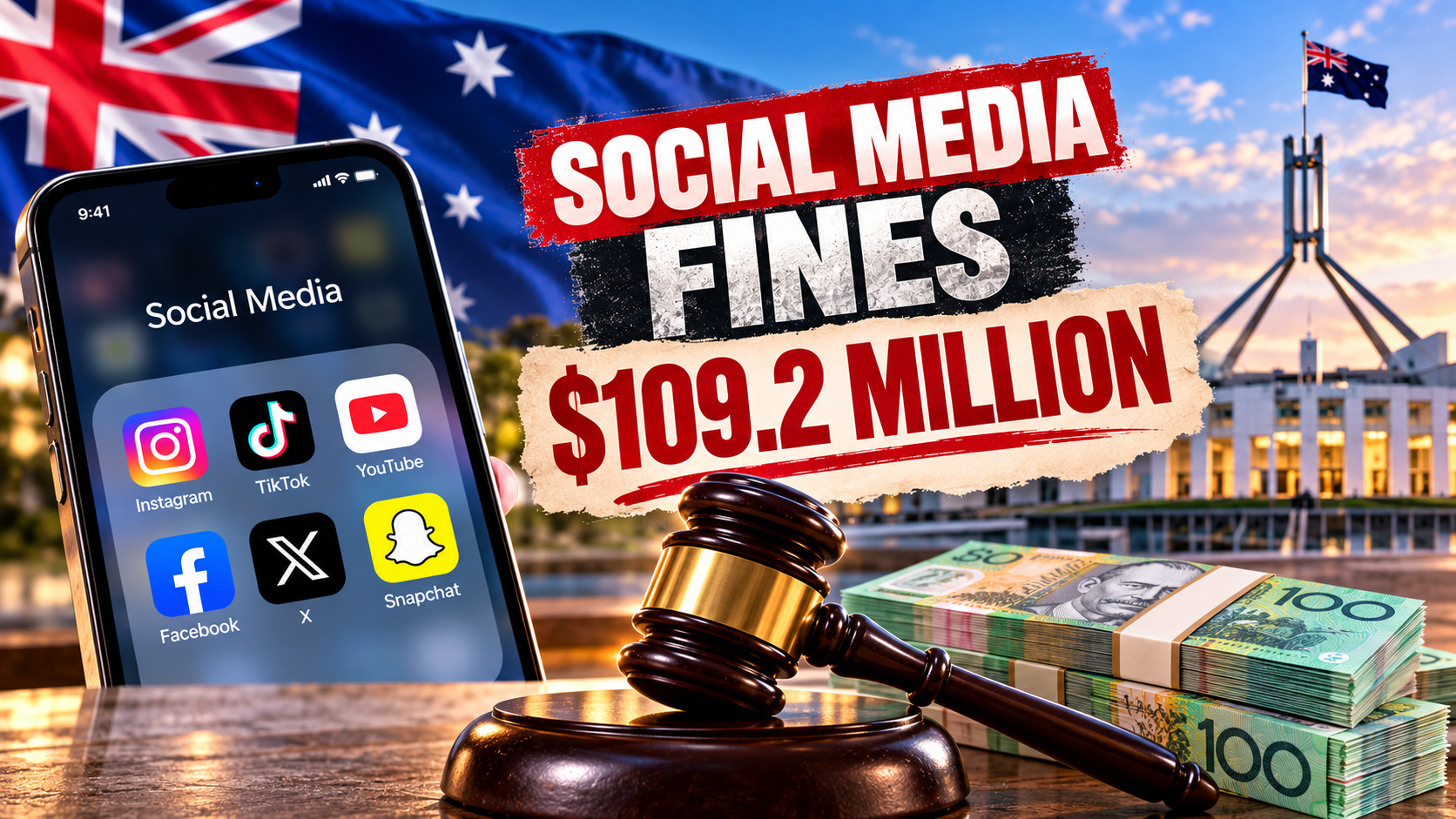
Australia has significantly increased the financial penalties facing social media companies that fail to enforce its under-16 restrictions, raising the stakes for global technology giants including Meta, TikTok and Google.
Australia is stepping up its efforts to hold major technology companies accountable, with the maximum penalty for breaches of its social media minimum-age requirements increasing to $109.2 million.
The tougher penalties, introduced through legislation passed in September 2026, strengthen the powers of Australia’s eSafety Commissioner to investigate potential breaches and take enforcement action against non-compliant platforms.
The changes form part of the government’s wider push to improve online safety for children while ensuring technology companies take greater responsibility for how their services operate in Australia.
For major social media platforms, the consequences extend beyond financial penalties. Companies must now navigate increasingly complex requirements involving age assurance, privacy protection and regulatory compliance.
Why Australia Doubled Social Media Fines
Australia’s social media minimum-age framework requires designated platforms to take reasonable steps to prevent children under 16 from holding accounts.
The legislation places responsibility on technology companies rather than parents or young users.
Under the original framework, companies faced maximum penalties of $49.5 million for systemic failures to comply with their obligations.
Following amendments passed in September 2026, the maximum corporate penalty increased to $109.2 million, substantially raising the potential financial consequences for major social media businesses.
The changes also provide the eSafety Commissioner with stronger investigative powers, including the ability to request information and documents from technology companies and relevant third-party providers.
This may include businesses involved in age verification, identity assurance and other services supporting social media platforms.
The government has also introduced higher infringement penalties for certain breaches, strengthening the regulator’s ability to respond to non-compliance.
The increased fines reflect growing expectations that global technology companies should invest in effective systems to meet their responsibilities under Australian law.
Which Social Media Platforms Are Affected?
Australia’s social media minimum-age restrictions apply to designated services, including some of the world’s largest social media platforms.
These include:
- Instagram and Facebook, owned by Meta
- TikTok
- YouTube, owned by Google
- Snapchat
- X, formerly Twitter
Other services may also fall within the regulatory framework depending on how they operate and whether they meet the legal criteria.
Not every online platform is automatically covered. Messaging services, gaming platforms and other digital products may be treated differently under the legislation.
For affected companies, compliance requires more than simply asking users to confirm their age when creating an account.
Platforms must take reasonable steps to prevent underage users from maintaining accounts, while balancing those requirements against privacy and data protection obligations.
How Will Social Media Companies Verify Users’ Ages?
Age assurance has become one of the biggest technological challenges associated with Australia’s social media restrictions.
Traditional methods, such as entering a date of birth during registration, provide limited protection because users can easily enter incorrect information.
Technology companies are therefore exploring more sophisticated ways to assess whether users meet minimum-age requirements.
These approaches may include facial age estimation, identity verification and other age-assurance technologies.
However, each method introduces potential concerns involving accuracy, accessibility and privacy.
Facial age estimation, for example, may help platforms assess whether a user is likely to meet an age threshold without requiring a government-issued identity document.
But such systems must still address questions about reliability, fairness and the handling of personal information.
Identity-based verification may offer another option, although it raises concerns about the amount of sensitive information users could be asked to provide.
Australia’s approach is likely to accelerate investment in age-assurance technology as companies seek practical ways to demonstrate compliance.
The challenge will be developing systems that are effective without creating unnecessary privacy risks for Australian users.
What Do the Higher Fines Mean for Meta, TikTok and Google?
For global technology companies, Australia’s tougher penalties increase the financial risks associated with failing to comply with online safety requirements.
Meta, which operates Facebook and Instagram, must ensure its systems are capable of identifying and restricting accounts belonging to users below the minimum age.
TikTok and Snapchat face similar challenges, particularly given the popularity of their services among younger audiences.
Google must also address the regulatory requirements affecting YouTube, while considering how restrictions interact with the platform’s wider video-sharing services.
The larger penalties could encourage technology companies to increase spending on compliance teams, age-assurance systems and internal monitoring.
However, the maximum fine does not represent an automatic penalty for every individual breach.
Enforcement outcomes depend on the nature of the alleged non-compliance, the relevant legal provisions and the applicable court processes.
The broader significance is that Australia’s regulatory framework now creates substantially greater financial exposure for companies that fail to meet their obligations.
Stronger Powers for Australia’s eSafety Commissioner
Alongside the increased penalties, the legislative changes strengthen the enforcement capabilities of Australia’s eSafety Commissioner.
The regulator has a central role in overseeing compliance with the country’s social media minimum-age requirements.
The expanded powers allow greater scrutiny of how technology companies implement age restrictions and whether their systems are operating effectively.
They also provide mechanisms for obtaining relevant evidence from third-party organisations involved in delivering age-assurance and related services.
This is particularly important because compliance may depend on technology and processes supplied by companies outside the social media platforms themselves.
For regulators, access to information about those systems could help determine whether companies are taking reasonable steps to prevent underage account holders.
For technology businesses, the changes reinforce the importance of maintaining appropriate records, reviewing compliance processes and being able to explain how their age-assurance systems work.
Could Australia’s Social Media Laws Influence Other Countries?
Australia’s approach to regulating social media access for children is attracting international attention.
Governments around the world are considering how to address concerns involving children’s online safety, harmful content and the responsibilities of major digital platforms.
Australia’s minimum-age restrictions represent one of the more significant attempts to place direct legal obligations on social media companies to limit access based on age.
The introduction of substantially higher penalties adds another dimension to the international debate.
Other governments may examine whether stronger enforcement measures encourage companies to make meaningful changes to their services.
For multinational technology businesses, the emergence of different age-restriction requirements across jurisdictions could create additional operational challenges.
Companies may eventually need age-assurance systems that can be adapted to different national laws without requiring entirely separate verification processes.
Whether Australia’s approach becomes a model for other countries will depend on its effectiveness, its impact on young users and how successfully it balances online safety with privacy.
What Does This Mean for Australian Parents and Social Media Users?
For Australian families, the legislation reinforces the government’s expectation that social media companies should take responsibility for enforcing minimum-age requirements.
The financial penalties target regulated businesses rather than children or parents.
Young Australians under 16 may be prevented from creating or maintaining accounts on covered services, while parents may need to consider alternative ways for their children to communicate and access age-appropriate digital content.
For adult users, the most noticeable changes may involve new age-assurance processes when registering for accounts or accessing existing services.
However, Australia’s framework does not require every social media user to provide government identification.
Platforms are expected to use appropriate methods to meet their obligations while complying with relevant privacy requirements.
As technology companies refine their systems, users may encounter different approaches to age verification across services.
The longer-term implications could extend beyond social media, particularly as age-assurance technologies become more widely adopted across digital platforms.
The Tech Boom’s Take: Australia’s Social Media Crackdown Is About More Than Fines
The increase in Australia’s maximum social media penalty to $109.2 million sends a strong message to global technology companies.
But the size of the fine is only one part of the story.
The more significant development may be how the legislation influences the technology companies use to verify age, protect personal information and demonstrate regulatory compliance.
Age assurance is becoming an increasingly important part of the digital economy, and Australia’s approach could accelerate the development of new verification tools.
At the same time, stronger regulation brings legitimate questions about privacy, effectiveness and whether restrictions can be implemented without creating unnecessary barriers for users.
Technology companies will need to show that their systems do more than satisfy regulatory requirements on paper.
They must demonstrate that their approaches are practical, reliable and capable of protecting younger users.
For Australia, the real measure of success will not be how much money regulators collect in fines, but whether the legislation delivers meaningful improvements in online safety.
As governments worldwide consider their own approaches to social media regulation, Australia’s experience could become an important test of how technology, public policy and digital rights can work together.
The Tech Boom will continue following developments in Australia’s online safety laws, age-assurance technology and the response from major social media companies.
Sources and Further Reading
- Australian Government — Online Safety Amendment (Social Media Minimum Age) Act 2024
- Australian Government — Stronger Online Safety Laws Pass
- eSafety Commissioner — Social Media Age Restrictions
- Department of Infrastructure — Online Safety