The United States has moved to stop Chinese companies renting American AI chips through data centres in other countries, and it has put four of Australia’s South-East Asian neighbours, plus Brazil, on a new watch list to do it. In an interim final rule released on Monday US time (early Tuesday in Australia), the Commerce Department’s Bureau of Industry and Security (BIS) said exporters will need a US licence to ship advanced AI chips and servers to Indonesia, Malaysia, Singapore, Thailand and Brazil, and that data centres anywhere in the world will need one if they supply large amounts of computing power to companies headquartered in China and other countries of concern.
The rule lands days after Jensen Huang resigned as Nvidia’s chief executive over his relationship with a former executive of Megaspeed, a Singapore company US officials suspect of funnelling Nvidia chips to China. Australia is not on the list of five, but two of the biggest Australian-founded data centre builders, AirTrunk and NEXTDC, now operate or are building large campuses in Malaysia. Here’s what the rule does, what we know about who it hits, and what it could mean closer to home.
What the new US rule does
According to the rule text and the BIS announcement, it has four main parts:
- A licence for remote access at scale. Exporters need a licence to send advanced AI chips and servers to a data centre, wherever it is located, if they know it will provide more than 12 million units of “aggregate TPP” (a US measure of total processing performance) to companies headquartered in China, Macau or other countries in the US “D:5” group of arms-embargoed destinations. The rule counts capacity across “linked” data centres, not just a single building. Data centres already serving such customers have 90 days from the rule taking effect to get a licence.
- A licence for five countries flagged as diversion risks. Shipping advanced AI chips to Indonesia, Malaysia, Singapore, Thailand or Brazil now needs a licence, reviewed case by case. BIS says these countries “present a higher-than-normal risk of diversion”. Chips going to companies headquartered in the US, or with a US ultimate parent, are excluded, provided the exporter files monthly reports.
- Tighter checks on chip factories and packagers that make advanced chips for designers in countries now facing a licence requirement.
- The Biden-era AI Diffusion Rule is formally scrapped. BIS says that rule was never enforced and that it announced the rescission in May 2025.
There is one notable exception. The remote-access licence does not apply to “commercial recommender systems, such as those used by online retailers or social media companies, as these functions do not pose the same national security threat.” The rule takes effect when it is published in the US Federal Register, followed by a 60-day comment period. (The rule uses “super intelligence”, or SI, in place of “artificial intelligence”, under a recent US executive order.)
Unusually, BIS’s own press release says the rule was “written by and at the direction of the Department of Treasury and the National Security Council”. Fortune highlighted that wording, noting the administration may remain split on how to act against chip smuggling, and The Next Web also drew attention to it.
Why Washington is doing this now
US rules already stop the most advanced AI chips being sold directly to Chinese companies. The gap, as The Register explains, was that nothing stopped those companies renting the same chips from a data centre in a third country. The Register notes that it is widely believed some of the data centre boom in Malaysia and Thailand was aimed at Chinese customers who could not import the hardware themselves.
The Nvidia scandal has put that gap under a spotlight. Megaspeed, the Singapore company at its centre, built data centres in Malaysia, according to The Register and Fortune. Megaspeed has denied sending chips to China. The Register reported, in an update on Tuesday, that the US Commerce and Justice departments had confirmed an ongoing criminal investigation into Megaspeed, and that Singapore says it asked US counterparts for help with its own investigation and received little support.
There is also an Australian thread. InnovationAus reported this week that Megaspeed has registered affiliates in the United States, Australia and other countries with a 29-year-old who listed his address as a newsagent and lottery retailer in a regional town outside Melbourne.
How Asia is reacting
Singapore’s Ministry of Digital Development and Information and its trade ministry issued a joint statement saying: “We are studying the details of this new measure carefully.” The ministries said they are engaging affected companies and US authorities, including on how to “facilitate trusted access for Singapore companies”, and that Singapore does “not condone companies using their association with Singapore to circumvent or violate the laws of other countries in their international business activities, including export controls.”
Malaysia had already moved before the rule. In a statement on 13 November, its Ministry of Investment, Trade and Industry (MITI) said it has never cleared Megaspeed or its Malaysian affiliate Speedmatrix, which it described as a tenant at data centres in Malaysia, and that it is working with customs to determine whether chips brought into the country were re-exported lawfully. Bringing AI chips into Malaysia does not currently require a permit, MITI said, though exporting or re-exporting high-performance US AI chips has required one since July 2025. Malaysia “will not allow itself to be used to get around export controls,” the ministry said.
Analysts expect the biggest impact in Malaysia. “For Malaysia, the controls could be disastrous,” Joshua Kurlantzick, a senior fellow at the Council on Foreign Relations, told Fortune. Neil Shah, vice president of research at Counterpoint, told The Register the burden now shifts to data centre operators: “They must prove to US regulators that their compute is not being funneled back to embargoed nations, or risk losing their own access to US silicon.”
Malaysian research house MBSB was more measured. In a note reported by TNGlobal, it said the immediate impact is likely to fall on GPU deployment and switching on capacity rather than construction, adding: “US chip controls mainly raise risks for future Chinese-linked phases; committed US-backed projects should remain intact.”
What it means for Australian data centre companies
Australia is not one of the five countries named, so the new destination licence does not apply to chips shipped here. But the remote-access rule applies to data centres “wherever located”, which includes Australia: any facility here supplying more than the 12 million TPP threshold to China-headquartered companies would need a licence for its chips.
The more direct exposure is in Malaysia, where Australian-founded operators have bet big:
- AirTrunk announced in April two more campuses in Johor, JHB3 and JHB4, which it says will take its Malaysian platform to more than 700MW of IT load across four campuses and about US$6.8 billion of committed investment. It says its existing JHB1 and JHB2 campuses are almost 100 per cent contracted, and that JHB2 drew strong commitments from its existing global cloud and AI customers.
- NEXTDC opened KL1 in Kuala Lumpur in May, its first international data centre, which it describes as an AI-ready facility designed for 65MW of IT capacity and an A$1 billion long-term investment. (We looked at NEXTDC’s shareholder battle earlier this month.)
How much the rule affects these businesses will depend on who owns the chips installed in their halls and who uses them. Under the rule, chips going to US-headquartered companies, such as the big American cloud providers, are excluded from the new five-country licence if the exporter files monthly reports, while chips for other customers need case-by-case approval. Neither AirTrunk nor NEXTDC had commented publicly on the rule at the time of writing, as far as we could find, and neither has said what share of its Malaysian capacity serves non-US customers.
For Australian businesses and consumers using cloud services hosted in Singapore or Malaysia, we have seen no sign of any immediate change to existing services. On our reading, the rule targets who can buy and access advanced AI computing power, not everyday cloud hosting, and recommendation systems of the kind online retailers and social networks run are explicitly carved out.
What we don’t know yet
- When it starts. The rule takes effect on publication in the Federal Register; that date had not been set in the version BIS released.
- How licences will be handled. BIS says applications will be reviewed case by case, but has not said how quickly or how many it expects to approve for operators in the five countries.
- Whether more countries are added. The rule lets the Commerce Secretary designate further countries, and says Commerce will consider consequences such as import restrictions and Entity List designations for countries that tolerate evasion.
- How Malaysia, Thailand, Indonesia and Brazil respond. Singapore has responded to the rule. Malaysia’s trade ministry commented on Megaspeed last week, but we did not find official responses to the rule itself from Malaysia, Thailand, Indonesia or Brazil at the time of writing.
Our read
This is the most significant change to US chip controls since the Nvidia scandal broke, and it shifts the job of policing who uses American AI chips onto data centre operators, many of them far from the US. For Australia, the immediate effect is indirect but real: some of the region’s fastest-growing AI infrastructure is being built by Australian-founded companies in exactly the countries Washington has now flagged. If licences are slow or tightly rationed, that could reshape where AI capacity gets built in the region, including whether more of it ends up in Australia itself. We will be watching for the Federal Register date and for any response from Canberra and the operators.
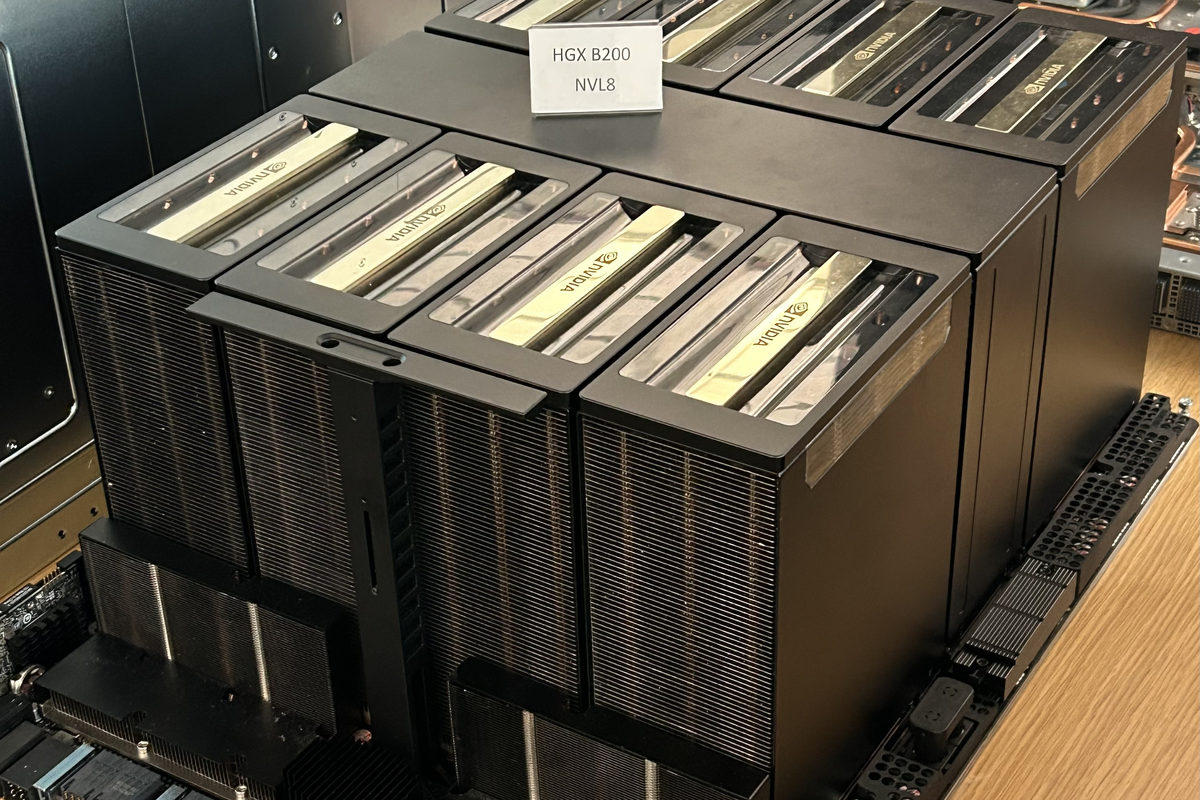
Featured image: an Nvidia HGX B200 eight-GPU board, the kind of advanced AI hardware covered by US export controls. Photo: Pokiiri, via Wikimedia Commons, licensed CC BY-SA 4.0; cropped to 3:2, resized and converted to PNG. The adapted image is licensed CC BY-SA 4.0. Nvidia’s name and logo are trademarks of their owner; their appearance does not imply endorsement.