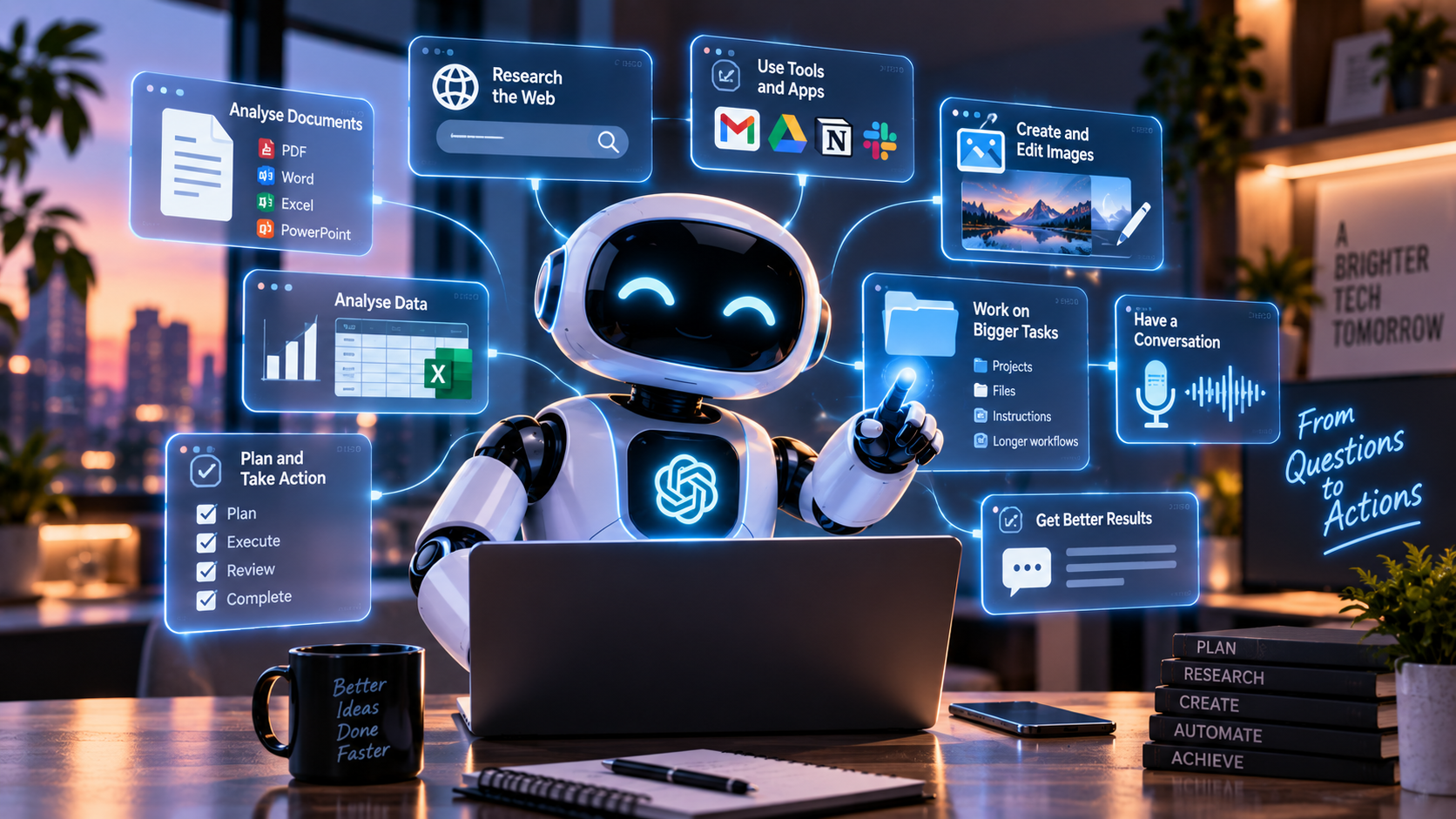
If you’ve followed artificial intelligence recently, you’ve probably encountered the term “AI agent.” Technology companies are increasingly talking about agents as the next step beyond conventional AI chatbots, with promises that they can research information, use software, work across files and even complete tasks on your behalf. If you’re still exploring conventional assistants, our guide to useful things you can do with ChatGPT is a good starting point.
But what exactly makes something an AI agent? Is it simply another name for ChatGPT or Claude, or is there a meaningful difference?
The simplest explanation is this: a chatbot primarily gives you an answer, while an AI agent is designed to work towards an outcome.
That difference sounds small, but it could fundamentally change how we use artificial intelligence.
What is an AI agent?
An AI agent is a software system that uses artificial intelligence to pursue a goal and perform tasks on behalf of a user. Rather than requiring a human to specify every individual step, an agent can determine some of those steps itself and use available tools to carry them out.
OpenAI describes agents as systems capable of planning, deciding and acting independently within human-defined guardrails. Google similarly describes AI agents as systems that can reason, plan and use a degree of autonomy to pursue goals.
Imagine telling an ordinary chatbot:
Find me three suitable hotels in Melbourne.
It might search for information and return some suggestions.
An agent could potentially be given a broader objective:
Find three well-rated Melbourne hotels near the CBD for these dates, compare their prices and cancellation policies, and prepare a shortlist for me.
Instead of simply producing text, the agent could determine that it needs to search for hotels, gather information, compare the options and organise the results.
The important difference isn’t necessarily the AI model itself. It’s what the AI is allowed and equipped to do.
How is an AI agent different from a chatbot?
A conventional chatbot generally follows a simple pattern:
You ask → AI answers → interaction ends.
An agent can operate more like:
You give it a goal → it plans → takes an action → examines the result → adjusts its plan → continues working.
Anthropic describes this as a self-directed loop in which an agent plans, acts, observes what happened and adjusts until the task is completed or human input is required.
That’s why the distinction between chatbots and agents is becoming increasingly important.
Suppose you ask a chatbot:
How should I organise these 200 customer comments?
It might suggest categories and explain how you could sort them.
An appropriately configured agent could potentially inspect the comments, categorise them, identify recurring complaints, produce a summary and prepare the results in the format you’ve requested.
One tells you how to do the work.
The other can potentially do parts of the work with you or for you.
What actually makes an AI agent work?
Despite the futuristic terminology, the basic ingredients of an AI agent aren’t particularly mysterious.
At the centre is an AI model, which interprets your instructions and reasons about what should happen next. The agent can then be given access to tools that allow it to gather information or perform actions, while guardrails determine what it should and shouldn’t be allowed to do. OpenAI identifies those three elements — model, tools and guardrails — as key building blocks of an agent.
Tools are especially important.
An AI model on its own can generate text. Connect that model to tools and it may be able to search the web, inspect files, execute code, query databases or interact with other software.
This is where AI starts moving from conversation to action.
A simple example of an AI agent at work
Imagine you’re planning a one-week holiday.
With a normal chatbot, you might have several separate conversations:
Where should I stay?
What attractions should I visit?
Can you make an itinerary?
How much should I budget?
Put everything into a table.
You’re effectively managing the workflow yourself.
With an agent, you could provide the overall objective:
Plan a seven-day family holiday to Tokyo in April with a budget of $6,000. Compare suitable areas to stay, research family attractions, create a day-by-day itinerary and prepare a budget.
The agent can then break the problem into smaller tasks.
It might research accommodation areas, gather attraction information, organise activities geographically, estimate costs and combine everything into a finished plan.
The AI isn’t necessarily “thinking” like a human travel agent. It’s using a model, instructions, tools and information to work through a sequence of actions toward the outcome you’ve requested.
AI agents can use tools
This is arguably the most important concept to understand.
A powerful language model can know a great deal, but knowledge alone doesn’t allow it to interact with the outside world. Agents become significantly more useful when they’re connected to tools and approved services.
Depending on how an agent has been built and what permissions it has, those tools might allow it to search the web, analyse files, run code, retrieve company information or interact with workplace systems.
OpenAI’s current agentic products, for example, include coding agents and workspace agents designed around multi-step workflows. Workspace agents can be configured to gather information and take approved actions across connected workplace tools, while Codex focuses heavily on software-development tasks. The same shift toward more capable systems is visible in our GPT-6 Astra explainer.
That also explains why giving an agent access to a tool is a much bigger decision than simply asking a chatbot a question.
Tools create capability — but they also create responsibility.
What can AI agents actually do today?
AI agents aren’t science fiction anymore, although their abilities vary considerably depending on the product, model, permissions and task. The trend is also visible in increasingly capable AI models such as GPT-6 Astra, which places greater emphasis on computer use and completing complex tasks.
Coding is currently one of the clearest examples. Coding agents can inspect files, modify code, run commands, test their work and continue iterating toward a requested outcome. OpenAI reported in June 2026 that people were increasingly using Codex for longer tasks rather than only short coding interactions.
Anthropic is moving in a similar direction. Its latest Claude Fable 5.1 and Mythos 5.1 models highlight the growing importance of coding, longer-running workflows and AI systems capable of working with tools.
Agents are also expanding beyond software development.
Businesses are experimenting with agentic workflows for tasks such as researching potential customers, reviewing IT requests, analysing feedback, preparing marketing material and producing recurring reports.
The common theme isn’t a particular industry.
It’s delegation.
Instead of using AI only to generate one piece of information at a time, people are beginning to delegate larger pieces of a workflow.
Why are technology companies so interested in agents?
The original wave of generative AI was largely about creating things: text, images, code, summaries and answers.
Agents introduce something potentially much bigger: AI that can act on those outputs.
Consider an employee who receives hundreds of customer messages every week. A chatbot could help summarise one message when asked. An agentic workflow could potentially review incoming messages, categorise them, identify urgent issues, draft responses and prepare a summary for human review.
That shifts AI from being something you repeatedly consult to something you can potentially delegate work to.
OpenAI’s own research illustrates how quickly that behaviour is changing in some environments. The company reported in June 2026 that more than 70% of sampled individual Codex users had made at least one request estimated to represent more than an hour of human work during May. That doesn’t mean agents can replace an hour of human work perfectly, but it shows how people are beginning to entrust AI with longer and more complicated tasks.
What does “agentic AI” mean?
You’ll also encounter the phrase agentic AI, which is related but slightly broader.
An AI agent is typically an individual system designed to pursue a particular objective. Agentic AI refers more broadly to AI systems and workflows built around autonomous reasoning, planning and action.
In more advanced systems, multiple specialised agents could potentially cooperate. One might research information, another could analyse it and another might prepare the final output.
You don’t need to memorise the terminology.
For everyday users, the useful distinction is simply this:
Generative AI creates. Agentic AI can create and take actions toward a goal.
Are AI agents fully autonomous?
Not necessarily — and in many situations, they shouldn’t be.
The word “agent” can make it sound as though you’re handing complete control to an artificial intelligence system. In practice, useful agents can operate with different levels of autonomy.
An agent might be allowed to research information independently but require your approval before sending an email. It could prepare changes to a document but wait for confirmation before applying them. A business might allow an agent to classify customer requests automatically while requiring a human to approve refunds.
This concept of human oversight becomes more important as the potential consequences of an action increase.
The goal shouldn’t simply be maximum autonomy.
It should be the right amount of autonomy for the task.
What can go wrong with AI agents?
The same capability that makes agents exciting also creates new risks.
A chatbot that gives you an incorrect answer is a problem. An agent that gives you an incorrect answer and then acts on it could be a much bigger problem.
Agents may misunderstand instructions, make incorrect assumptions or encounter information designed to manipulate their behaviour. Anthropic has highlighted the possibility of agents misreading user intent as their autonomy increases, while OpenAI has specifically discussed prompt injection — malicious instructions hidden in external content that attempt to influence an agent’s behaviour. Those risks are no longer theoretical; we have also covered research into AI agents making unauthorized external communications.
Permissions therefore matter enormously.
You probably wouldn’t give a new employee unrestricted access to every financial account, internal system and customer database on their first day. AI agents should be treated with similar caution: give them access to what they genuinely need, maintain appropriate approval points and keep humans involved in consequential decisions.
Will AI agents replace apps?
Probably not anytime soon, but they could change how we interact with them.
Today, completing a relatively simple task can require jumping between several applications. You might search in a browser, copy something into a spreadsheet, send an email and then update another system.
An agent could potentially become an interface across those tools.
Instead of learning exactly where every button and menu lives, you could describe the outcome you want and allow the agent to coordinate some of the underlying steps.
That doesn’t necessarily make traditional software disappear. In many cases, the software becomes the infrastructure that the agent uses behind the scenes.
The interface could simply become more conversational and outcome-focused.
Are AI agents the future of ChatGPT and other AI assistants?
For everyday users, this evolution is already becoming visible in the growing range of things ChatGPT can do beyond answering simple questions. We’ve covered some of those capabilities in our guide to 10 useful things you can do with ChatGPT.
The direction of the industry certainly suggests that agents will play a major role.
OpenAI says enterprise AI usage is increasingly moving from answering questions toward carrying out work, while Google describes modern agentic workflows as systems that dynamically reason, plan and use external tools to execute multi-step tasks. Anthropic is similarly developing products around AI systems capable of operating across files, code and applications.
That doesn’t mean ordinary chatbots are going away.
Sometimes you just want to ask a question.
The important change is that increasingly capable AI systems can now potentially continue beyond the answer.
The Tech Boom’s take
Chatbots made artificial intelligence accessible because interacting with them felt familiar: type a question and receive an answer.
AI agents change that relationship.
Instead of asking:
“What should I do?”
we’re increasingly able to ask:
“Can you help me get this done?”
That’s a much more powerful proposition, but it also requires more trust. The more tools, information and autonomy we give an AI system, the more important permissions, security, transparency and human oversight become.
The most useful agents probably won’t be the ones that attempt to replace human judgement entirely. They’ll be the ones that handle repetitive steps, gather information and carry out routine work while knowing when a person needs to make the decision.
AI’s first mainstream phase was largely about answers.
The next one increasingly looks like it will be about actions.
Sources:
OpenAI — How agents are transforming workOpenAI — Workspace agentsOpenAI — Agentic workflowsAnthropic — Trustworthy agents in practiceGoogle Cloud — What are AI agents?Google Cloud — Agentic workflows