Phone makers are heading for a second bad year in a row. Market analyst Counterpoint Research now expects global smartphone shipments to fall a further 6% in 2027, after a drop of about 14% this year. Its reason is the same one behind this year’s price rises: memory chips are being sold to AI data centres first, and phones are getting what’s left.
For Australians, that matters more than the shipment numbers. Samsung, Google and Apple have already raised local prices on phones that were on sale this year, and the forecast suggests the pressure on cheaper models won’t ease quickly. Here’s what the analysts are actually saying, what has already happened to prices here, and what to do if you need a new phone.
What Counterpoint is forecasting
Counterpoint published the update to its Smartphone Market Outlook Tracker on 25 November. The headline numbers:
- 2026: global shipments down 13.9% year on year (rounded to 14% in Counterpoint’s summary).
- 2027: down a further 6%.
- 2028: a rebound of 6%, but the market would still be about 14% smaller than in 2025, and Counterpoint doesn’t expect it to get back to 2025 levels by 2030.
- Apple and Samsung hold up best. Counterpoint forecasts Apple shipments to fall 1% in 2026 and 4% in 2027, and Samsung’s to fall 1% and 3%. Apple is expected to stay the largest vendor in both years, but only narrowly.
- Huawei is the exception this year, with shipments forecast to rise 12% in 2026 on the back of its position in China, before it too declines in 2027.
Principal analyst Yang Wang said the industry had hoped this year would be the bottom. “The 2026 decline was initially expected to mark the low point of the cycle, but the memory situation has remained more restrictive than anticipated,” he said. “The result is a much weaker 2027, particularly for lower priced devices and price sensitive markets.”
Remember that these are forecasts, not sales results. Counterpoint itself says the size of any 2028 recovery depends on how quickly cheaper components flow through to shop prices, and on whether AI and server demand keeps taking priority. The Register, which reported the forecast on 27 November, notes that the industry has already had a very rough 2026.
Why memory is the problem
Phones need two kinds of memory: DRAM (the working memory, often listed as RAM) and NAND flash (storage). The same chip makers also supply the high-bandwidth memory used in AI servers, and that business is far more profitable. Counterpoint says mobile memory “remains the principal constraint” because supplier allocation “continues to favour AI and server applications”. It also expects further price increases for LPDDR, the low-power memory used in phones, in early 2027.
Research firm IDC put the scale of the problem in October, when it reported that third-quarter 2026 shipments had fallen a record 22% year on year to 255.3 million phones. IDC said memory costs had risen about 350% in a year. IDC’s Nabila Popal warned that “the worst is yet to come”, adding: “Current indicators suggest that the market has not yet reached the bottom.” Her comments were reported by The Register and Tom’s Guide.
Counterpoint says manufacturers have responded by raising prices, cutting low-memory configurations and dropping models that no longer make money. That is squeezing the cheapest end of the market hardest. Phones priced under US$200 are becoming scarcer, according to Counterpoint, and the ones that remain are clustering towards the top of that price band.
It isn’t only phones. Valve has said rising memory and storage costs mean it can’t yet say how many more Steam Machine units it can build, or at what price.
What has already happened to phone prices in Australia
Australian buyers have been feeling this all year. When Samsung announced the Galaxy S26 in February, the base 256GB model was A$1,549, up from A$1,399 for the equivalent Galaxy S25, as Information Age reported. Samsung then put prices up again on phones already on sale. According to WhistleOut, by early October the Galaxy S26 started at A$1,649 and the 1TB Galaxy S26 Ultra had risen A$250 to A$3,199.
Cheaper phones haven’t escaped. WhistleOut reported in October that Google’s Pixel 10a had risen from A$849 to A$949, the Galaxy A57 (128GB) from A$749 to A$849 and the entry-level Galaxy A17 from A$349 to A$399. It also reported that when Apple launched the iPhone 18 Pro in September it raised prices on several older iPhones, most by A$100 to A$150.
The ABC explained the cause in September. Citing the WA Data Science Innovation Hub, it reported that a 16-gigabyte RAM chip that cost as little as $4.76 last year could cost almost $60 by June.
These are recommended retail prices as reported at the time, and they can change. Retailers often sell below them: WhistleOut noted JB Hi-Fi discounts on some Samsung models even after the official increases. Check the current price before you buy.
Deals now, or wait until 2028?
The analysts aren’t telling buyers to wait. In the US, Counterpoint’s separate quarterly report found smartphone shipments fell 9% year on year in the third quarter, and Apple’s US share rose from 50% to 57% as cheaper Android brands lost ground, MacRumors and CNET reported. “Consumers are timing their purchases around the best deals more than ever, if they buy at all,” Counterpoint senior analyst Maurice Klaehne said, as quoted by CNET.
Our read: if your current phone still works well and gets security updates, there is no reason to rush, and the forecast gives you no reason to expect a cheaper new phone in 2027. If you do need to replace one soon, the Black Friday and Christmas sales are a sensible time to buy. Some practical points:
- Compare retailer prices with the brand’s own store. Australian retailers have been discounting below the raised recommended prices.
- Think about storage before you buy. Bigger storage tiers have had some of the steepest increases. Work out what you really use before paying for 512GB or 1TB.
- Look at refurbished phones and last year’s models. Counterpoint expects more people to keep phones longer or buy refurbished. A reputable refurbished phone with a warranty can make sense, as long as it still gets software updates.
- Make your current phone last. A new battery or a case and screen protector costs far less than a new handset.
- Budget phones are where prices are moving most. If you’re buying a phone for a child or a parent, check what’s left in the cheaper range now rather than counting on a bargain later.
What we don’t know
Counterpoint’s figures are global, and this release doesn’t break out Australia. It says the hardest-hit areas will be lower-priced devices and price-sensitive markets, so shipments here may not move in exactly the same way. Nobody has announced new Australian price changes for 2027. Whether prices rise again depends on memory contracts, the Australian dollar and each brand’s own decisions.
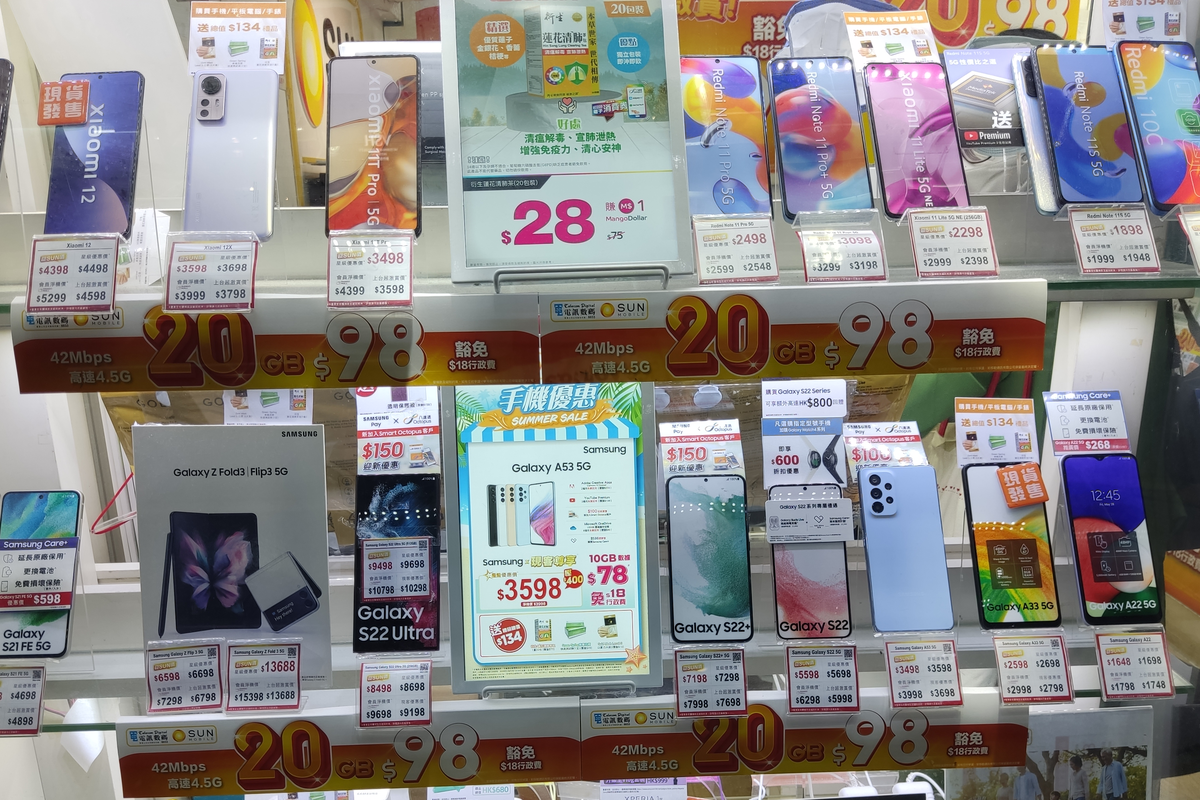
Sources: Counterpoint Research Smartphone Market Outlook (25 November 2026); IDC third-quarter 2026 shipment data as reported by The Register and Tom’s Guide; Counterpoint US Market Monitor as reported by MacRumors and CNET; The Register (27 November 2026); WhistleOut Australian price reports (2 October and 12 October 2026); Information Age; ABC News. Featured photo: smartphones for sale in a SmarTone shop window on Wan Chai Road, Hong Kong, June 2022, by CHOADAICHONG MinuddR via Wikimedia Commons, licensed under CC BY-SA 4.0; cropped, resized and converted to PNG. Prices shown in the photo are in Hong Kong dollars. No endorsement by the retailer, brands or photographer implied.