A federal jury in Brooklyn has found Huawei Technologies and three of its subsidiaries guilty on 10 of 12 criminal counts, including sanctions violations involving Iran, bank and wire fraud, money laundering conspiracy and conspiracy to steal trade secrets from US companies. The verdict was returned on Tuesday 24 November in New York, which was Wednesday 25 November in Sydney. Jurors cleared Huawei of racketeering conspiracy, the most serious charge, and of conspiracy to obstruct justice. We covered the start of the case in our earlier report on the trial, which was written before there was a verdict.
Huawei says it will fight on. This article sets out what the jury decided, what each side is saying, what has not yet been decided, and what it does and does not change for people and businesses in Australia.
What the jury decided
The case was heard in the Eastern District of New York over about three months. The Justice Department’s announcement lists the offences the jury found proved, and CourtNews reports that the department said at least one defendant was convicted of each, so the outcome differs by company:
- conspiracy to steal trade secrets;
- conspiracy to commit wire and bank fraud, wire fraud and bank fraud;
- conspiracy to defraud the United States;
- conspiracy to violate, and substantive violations of, the International Emergency Economic Powers Act (the US law used to impose the sanctions on Iran);
- money laundering conspiracy.
The four convicted defendants are Huawei Technologies, its Chinese subsidiary Huawei Device Co., and two US subsidiaries, Futurewei Technologies and Huawei Device USA, according to the DOJ. The not-guilty verdicts on racketeering and obstruction matter because, as CourtNews reports citing TIME, a racketeering conviction could have exposed parts of Huawei’s enterprise to forfeiture.
What prosecutors said they proved
The Justice Department’s account is a prosecution account, but it is now backed by a jury verdict on the counts above. It says Huawei ran its Iran business through a company called Skycom while telling banks, journalists and the US government that Skycom was only a business partner and that Huawei complied with sanctions. In fact, the department says, Skycom was a wholly owned subsidiary, and the false statements helped Huawei obtain billions of US dollars and access to US-dollar clearing. It also says Huawei helped Iran monitor and censor internet use and supplied surveillance cameras used to watch protests.
On trade secrets, the department pointed to several examples shown at trial:
- T-Mobile’s “Tappy” touchscreen-testing robot: Huawei signed a non-disclosure agreement intending to breach it, sent photos and technical details to China, and a Huawei employee took part of the robot out of a T-Mobile lab in a backpack.
- Cisco router source code, which the department describes as Cisco’s “crown jewel”; engineers left in notes that referred to “ocsic”, Cisco backwards.
- Fujitsu equipment photographed by an employee wearing a badge that said “Weihua” rather than Huawei.
- CNEX, where a university researcher was used to reach the company’s hardware without disclosing he was acting for Huawei, and Quintel, whose confidential antenna slide was attached to a Huawei patent application.
Huawei’s response
Huawei’s statement from Shenzhen on 25 November welcomes the racketeering acquittal as vindication of its position over eight years, and calls the remaining charges “equally without legal or factual merit”. It argues that the five trade-secret disputes the government cited were civil matters resolved over the past two decades, that no court ever found it liable for wilful misappropriation, and that it will take “all necessary legal actions”.
Outside court, Huawei lawyer Brian Heberlig described the thefts shown at trial as “isolated misconduct by company employees” in a company with “hundreds of thousands of people”, and called the racketeering result a “profound rejection of the United States’ narratives about what Huawei is”, as Ars Technica reported. China’s foreign ministry said Beijing “firmly opposes the US suppressing and containing Chinese enterprises”, according to Channel NewsAsia.
What happens next
- Sentencing: set for 14 September 2027 before Judge Ann Donnelly. The Justice Department says the defendants face criminal fines, forfeiture and restitution. No amount has been set.
- Pre-sentencing motions: CourtNews, citing TIME, says these are expected to begin in the third week of January 2027.
- Appeal: Huawei’s lawyer says the company expects to appeal. CourtNews notes that appeals in federal criminal cases ordinarily follow a final judgment, so one would normally come after sentencing.
- A second case: a separate US trade-secret case against two Huawei subsidiaries in Seattle has been repeatedly delayed, with trial currently set for October 2027, per CourtNews citing TIME.
The timing is politically awkward. The verdict came five days after Donald Trump met Xi Jinping in Shenzhen, and Ars Technica says it risks inflaming US-China tensions. Huawei has been on a US trade blacklist since 2019, and the ABC reports that experts say the case has not undermined a company that has diversified and become a key player in China’s AI push, so the commercial effect may come mainly from the eventual penalties.
What it means in Australia
Australia is not a party to this case, and in the coverage we reviewed we found no Australian government or Huawei Australia statement responding to the verdict. The ABC notes that Huawei has more than 200,000 employees and operates in about 170 countries, including Australia.
The longer-running Australian decision predates the verdict. On 23 August 2018 the government issued 5G security guidance saying vendors likely to be subject to directions from a foreign government that conflict with Australian law could prevent a carrier from adequately protecting its network. The statement did not name Huawei or ZTE, but the Sydney Morning Herald reported at the time that Huawei said the government had told it directly that it was excluded; Al Jazeera’s history of the case says Australia and New Zealand joined the US in banning Huawei from supplying 5G equipment in 2018.
Our read: nothing in the verdict, the Justice Department release or the coverage we reviewed orders or announces any change to what Australian consumers or telcos can buy or use. The convictions concern US sanctions, fraud and trade-secret law, not the security of Huawei devices. Practically, a few things are worth watching:
- Consumers: there is no new product safety warning here. If you own a Huawei phone, watch or other device, nothing in this verdict requires action.
- Businesses with US exposure: companies that deal with Huawei and also use US banks, US-origin technology or US partners should check their sanctions and supplier-risk policies, because the IEEPA convictions show US prosecutors will pursue these cases.
- Policy: the penalties in September 2027 and any appeal are the next moments when governments, including Australia’s, may be asked to comment. We will update this article if that happens.
What is still uncertain: the size of any fine or forfeiture, how an appeal will go, and whether the verdict changes any government’s stance on Huawei equipment. Huawei’s denials of wrongdoing are part of the record, and the company says it will contest the verdict.
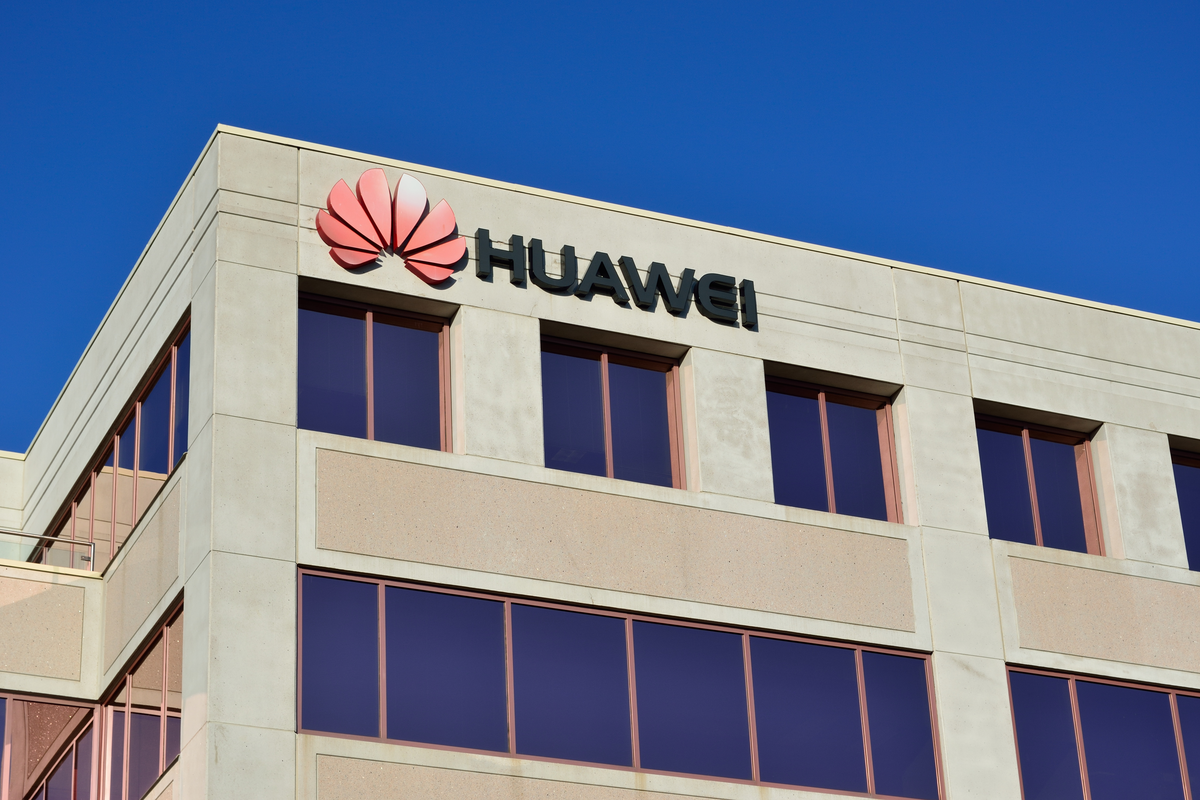
Sources: US Department of Justice, Huawei and subsidiaries convicted (24 November); Huawei, statement on the jury verdict (25 November); Ars Technica and Channel NewsAsia (25 November); CourtNews case summary; ABC News (25 November); Al Jazeera (25 November); Government 5G security guidance (23 August 2018, via ParlInfo); Sydney Morning Herald (23 August 2018). Featured photo: the Huawei sign on an office building in Canada, by Raysonho, via Wikimedia Commons, released under CC0 1.0 (public domain dedication); cropped and converted to PNG. Illustrative only: the building is not connected to the case.