Four years after NASA deliberately crashed a spacecraft into a small asteroid, Europe’s Hera probe has finally seen the damage up close, and it is far more dramatic than a dent. The first close-up images, released by the European Space Agency (ESA) on Wednesday 25 November (Berlin time), show that NASA’s DART impact flattened one whole face of the asteroid Dimorphos into a crater about the size of a sports stadium, left the asteroid tumbling, and that the pair of asteroids is surrounded by hundreds of previously unknown boulders.
It is the first time anyone has inspected the aftermath of what ESA calls humankind’s first planetary defence experiment. Here is what Hera found, why it matters for protecting Earth, and what is still unknown.
What Hera found
According to ESA’s announcement, made at a media conference in the dinosaur hall of the Museum für Naturkunde in Berlin, there are three headline findings:
- A crater as wide as the asteroid. “The face struck by DART has been flattened into an impact crater the size of a sports stadium, which extends across the asteroid’s entire width,” said Hera principal investigator Patrick Michel of CNRS / Observatoire de la Côte d’Azur.
- A tumbling moonlet. “As Hera returned more images, it became clear that the DART impact has left Dimorphos tumbling wildly in its orbit,” said ESA’s Hera mission scientist Michael Kueppers.
- A swarm of boulders. Hera’s long-exposure images show hundreds of orbiting boulders just a few metres across around the two asteroids. Kueppers said the team “will have to take account of these objects in the coming weeks” as the spacecraft moves closer.
The rest of Dimorphos looks largely unchanged, ESA says: boulder fields on its other regions match DART’s 2022 images. The larger asteroid, Didymos, also shows no apparent change from the impact.
“Scientists debated whether Dimorphos had sustained an impact crater, changed its shape or stayed the same,” Michel said. “Much to our surprise the answer turns out to be all three at once!” Speaking to Ars Technica, he put it this way: “we are in a sort of a transition between just cratering and global transformation, and we are still not sure how this can happen.”
A quick refresher: what DART did
Dimorphos is a 151-metre moonlet orbiting the 730-metre asteroid Didymos. Neither poses any risk to Earth; the pair is currently about 193.5 million km away. On 26 September 2022, NASA’s Double Asteroid Redirection Test (DART) spacecraft hit Dimorphos at about 6.14 km per second, Ars Technica reports, shortening its roughly 12-hour orbit around Didymos by about 33 minutes. ESA calls that “much greater than predicted”.
Telescopes on Earth could measure that orbit change, but they could not show what had happened to Dimorphos itself. DART was destroyed in the impact. That is the gap Hera was built to fill.
The pictures
The sharpest view comes from Hera’s monochrome Asteroid Framing Camera. Germany’s space agency DLR says one image was taken on 7 November 2026 from 29 km away, at about 2.7 metres per pixel. It shows Dimorphos with its flattened face and structures inside the crater, including what ESA and DLR describe as a “cigar-shaped” feature at its centre. ESA has also published a before-and-after comparison that pairs DART’s last view of Dimorphos with a Hera image taken from a similar angle.
Hera is observing with three instruments: the Asteroid Framing Camera, the HyperScout H multispectral camera that sees 25 colours at once, and the Thermal Infrared Imager supplied by Japan’s space agency, JAXA. The small-car-sized spacecraft is flying about 25 to 30 km from the asteroids, moving at an average of just 12 cm per second on ‘rectangular’ paths held with thruster firings. The Planetary Society has a gallery of the released images.
Why a bigger crater matters for planetary defence
DART tested the simplest way to move a dangerous asteroid: hit it hard. How much a hit moves an asteroid depends not just on the impactor but on how the asteroid responds, including how much material it throws off, since, as CNET explains, that debris adds extra recoil. A crater that spans the whole face, plus a change in shape, is exactly the kind of response scientists need to understand to model that push for other asteroids.
The next key number is Dimorphos’s mass. As The Register notes, combining the mass with the measured orbit change will show how effectively DART transferred momentum, which improves predictions for any future deflection attempt. Ars Technica adds that because near-Earth asteroids vary widely in shape, density and makeup, solid data from Dimorphos will anchor the computer models used to plan deflections.
Hera mission manager Ian Carnelli framed it as the two missions completing each other: “NASA’s DART mission demonstrated that we can change an asteroid’s orbit. Hera is now revealing what happened to the asteroid itself.”
Our view (analysis)
The tumbling and the boulder swarm are as important as the crater. A tumbling target is harder to model, and debris left orbiting an asteroid is a real hazard for any spacecraft sent to study or nudge one. Both are lessons that only a follow-up visit could deliver. It has been a big month for ESA’s deep-space missions, with BepiColombo now in orbit around Mercury as well.
What Hera has not done is change the basic verdict: DART showed that a kinetic impactor can move a small asteroid. What is now in question is how predictable that push is for asteroids built like Dimorphos.
What happens next
- December 2026: Hera is scheduled to move to around 13 km from the asteroid pair for higher-resolution images, according to ESA.
- January 2027: Hera plans to release two shoebox-sized CubeSats. Luxembourg-led Juventas will use low-frequency radar to probe an asteroid’s interior for the first time and will eventually attempt a landing. Italian-led Milani will study surface materials and dust.
- The next six months: Ars Technica reports Hera will keep moving closer over that period.
- April 2029: ESA and JAXA are developing Ramses to study asteroid Apophis during its close but entirely safe flyby of Earth on Friday 13 April 2029, when it will pass about 32,000 km above the surface.
What we don’t know yet
- Dimorphos’s mass, and therefore exactly how efficiently DART pushed it.
- How the impact produced a crater this large and reshaped the asteroid. Michel told Ars the team is “still not sure how this can happen.”
- Where the newly found boulders came from, and how much of a hazard they pose as Hera and its CubeSats move closer. ESA has not said.
- Whether Dimorphos will keep tumbling or settle back into a steady spin, and how long that might take.
Sources: ESA announcement, 25 November 2026, ESA before-and-after comparison, DLR image release, Ars Technica, The Register, The Planetary Society, CNET.
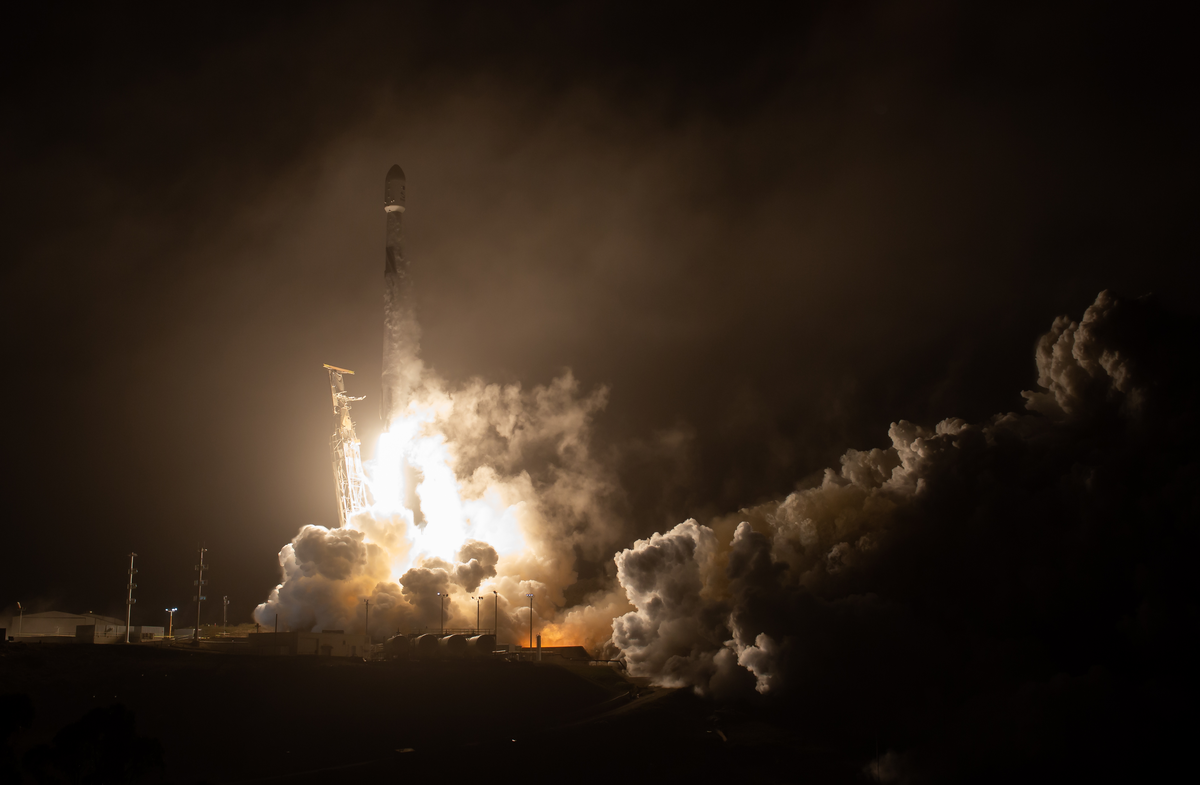
Photo: The SpaceX Falcon 9 carrying NASA’s DART spacecraft lifts off from Vandenberg Space Force Base, California, on 23 November 2021 (Pacific time). NASA/Bill Ingalls via Wikimedia Commons, public domain under NASA’s media usage guidelines (resized). No NASA endorsement implied.