Australia’s promised AI laws won’t be arriving before Christmas in any finished form. At his end-of-year press conference in Canberra on Friday 27 November, Prime Minister Anthony Albanese said the government had not yet started writing the legislation. “Look, we haven’t got down to the point of drafting legislation,” he told reporters, according to the official transcript.
That is a change of pace. In September Mr Albanese said there would be legislation on Australian AI standards before the end of the year. Now the government wants another round of consultation, prompted by a cross-party parliamentary inquiry that handed down 46 recommendations on Tuesday. Here is what he said, what the committee wants, and what it means for Australians and the businesses using AI.
What the Prime Minister said
Asked whether the AI legislation would be rushed through early next year, and whether it would come as one bill or several, Mr Albanese said the government had only just received the committee’s report. When a journalist interjected, “Sorry, you said there’d be a draft by the end of the year,” he replied: “We haven’t got down to drafting legislation.” He added: “You don’t receive a report of a joint committee this week and then produce legislation.”
He promised broad consultation, naming the creative sector and the business community. “There’s going to be a lot of consultation, and we will undertake that,” he said. He also left open whether there would be a single AI law: “We haven’t landed a final thing of whether there’ll be one piece of legislation or multiples.” Existing laws would also need changing to deal with AI, he said, “in particular national security legislation”. He named Attorney-General Michelle Rowland as having particular responsibility for many of the issues.
ABC News reported the exchange live on Friday, and InnovationAus said on Saturday that the Prime Minister had “walked back” plans to release draft legislation by the end of the year.
How the timeline slipped
The government has been signalling for months that AI laws were coming soon. InnovationAus reports that Mr Albanese’s July speech at the University of Sydney pointed to legislation being introduced in Parliament’s last sitting week, to be dealt with in early 2027. At a press conference at Apple Park in California on 20 September, he said: “like I said we’ll have legislation before the end of the year on Australian AI standards.” Days later InnovationAus reported that the government had brought its AI regulation timeline forward, with legislation expected by the end of the year rather than early 2027.
On 10 November the government announced that mandatory safety and security rules for frontier AI companies, meaning developers of the most advanced models, would be written into AI Standards legislation and enforced by a new AI safety regulator. Companies would have to identify and manage serious risks, allow independent evaluation of their models and rapidly notify the government of incidents. The next day the ABC reported the government would also consider a new criminal offence for AI companies that fail to prevent harm by their models, as part of its response to September’s OpenAI Medicare statistics incident. At that point, the ABC said, the rest of the AI standards were expected by the end of the year.
By the time the committee reported on 24 November, the ABC was reporting that draft laws were expected early next year, probably as a series of bills covering data centre standards, AI safety and copyright. Friday’s comments suggest even that is not locked in.
What the AI committee recommended
The Joint Select Committee on Artificial Intelligence, chaired by Labor MP Jo Briskey with the Liberals’ Jonno Duniam as deputy and independent MP Kate Chaney as a member, tabled its final report, Artificial Intelligence – the Australian way, on 24 November. The list of recommendations published by Parliament includes:
- Safety rules with teeth: a risk-based framework of standards for developing and deploying AI, covering testing, cybersecurity, transparency and human oversight, with “a robust compliance and penalties mechanism for breaches”.
- Obligations on frontier labs: timely incident reporting to the government, independent evaluation and auditing, and early access to new models for agencies such as the Australian Signals Directorate and the AI Safety Institute.
- More money for the AI Safety Institute: the report asks the government to urgently consider extra funding. The ABC reported the committee wants it boosted at least tenfold from its current $30 million over four years.
- Data centres: a licensing framework to enforce AI infrastructure standards, and a suggestion that the government consider reserving some computing capacity in big AI projects for the national interest.
- Deepfakes and likeness: considering mandatory machine-readable labels on AI-generated or materially altered photos, video and voice recordings, considering ways to give people control over how their face, voice and likeness are used, and examining a ban on deepfakes in political advertising.
- Everyday harms: looking at children’s use of AI chatbots and AI-generated intimate imagery, how general-purpose chatbots are used for mental health, legal and financial advice, and making sure people or companies stay legally accountable when AI agents act on their behalf.
- Copyright: eight recommendations (31 to 38), including a mechanism to make it “easier and fairer” for Australian creators to be paid by AI companies training models here, and a requirement that those companies be transparent about the data they train on.
- Ongoing oversight: a permanent parliamentary committee on AI.
These are recommendations, not law. Mr Albanese said the government would now discuss the report through its own committees; he did not give a date for a formal response.
The copyright fight isn’t settled
Copyright is the most contested part. The committee wants a payment mechanism for creators, but music industry body ARIA rejected the premise. “We reject the notion expressed in the majority committee report that existing copyright law does not work and that we need a so-called ‘fairer way to ensure creators get paid’,” ARIA chief executive Annabelle Herd said, as reported by the ABC. News Corp Australasia’s Michael Miller warned that a framework letting AI platforms scrape content without voluntary agreements would be “state-sanctioned theft”.
Independent senator David Pocock wrote a dissenting report, criticising what he called “heroic assumptions” about the benefits of hosting frontier AI training, and called for a three-year freeze on copyright changes. The Copyright Agency, which collects licence fees for authors and publishers, said the recommendations offered “limited detail about how these would be achieved”. With the Prime Minister singling out the creative sector for consultation, this is likely to be one of the slowest parts to resolve.
What it means for you right now
Nothing changes today. No AI-specific law is in force and none will pass before Parliament returns next year. Existing laws, such as privacy and consumer law, still apply to AI products, and the Digital Duty of Care passed this week covers AI chatbots alongside social media, games and apps, although its obligations don’t take effect for 12 months.
Our read: for most businesses using off-the-shelf AI tools, the frontier-lab rules (incident reporting, independent testing, early model access) are aimed at the big developers, not at you. But the direction is clear enough to plan for. Expect pressure to label AI-generated content, to explain when AI is making decisions about people, and to stay accountable for what AI agents do in your name. If you build or train models in Australia, the copyright and training-data transparency proposals matter most. We covered why the government wants AI companies to prove their systems are safe after the Medicare incident in October.
What we don’t know
- Whether any exposure draft will be published before the end of the year. InnovationAus thinks it is unlikely to be public before next year, and the Prime Minister gave no date.
- Whether the rules will come as one AI law or several bills across different portfolios.
- How the proposed AI safety regulator will be set up and funded, and how big its penalties will be.
- When the government will formally respond to the committee’s 46 recommendations, and which ones it will accept.
- How the government will resolve the copyright dispute between AI developers and creators.
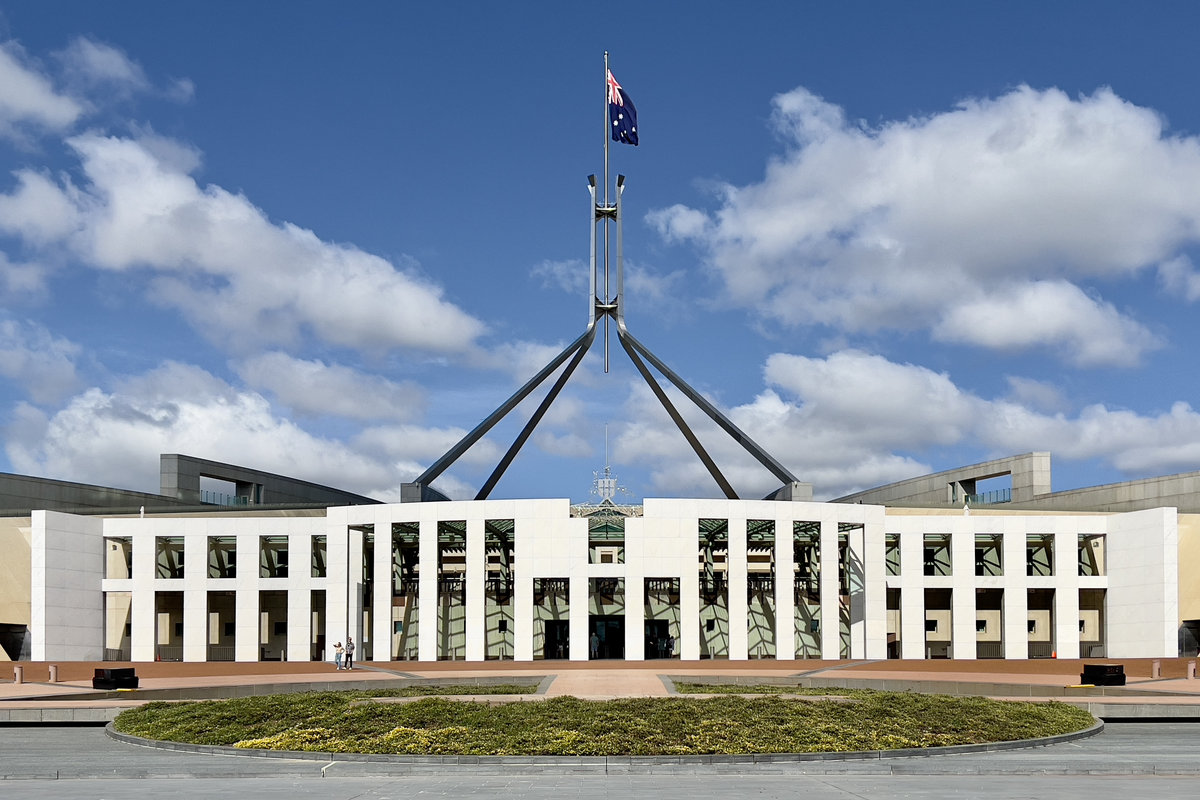
Sources: Prime Minister’s press conference transcript, 27 November 2026; ABC News live coverage (27 November); InnovationAus (28 November) and InnovationAus (26 September); Prime Minister’s Apple Park press conference (20 September); government media release (10 November); ABC News (11 November); Joint Select Committee on Artificial Intelligence, list of recommendations (24 November); ABC News (24 November); Copyright Agency. Featured photo: Parliament House, Canberra, 12 March 2022, by Chris Olszewski (Kgbo) via Wikimedia Commons, licensed under CC BY-SA 4.0; cropped, resized and converted to PNG. No endorsement by the photographer implied.