Amazon’s Ring has finally put a price and a date on the flying indoor security camera it first showed off in 2020. The Ring Drone Cam is a 165-gram drone that lives in a dock, takes off when an alarm sensor trips or a patrol is scheduled, and flies through the house filming in 2K. It costs US$249.99 and is due to ship in the US on 27 January 2027, although it still needs approval from the US Federal Communications Commission (FCC) before it can go on sale.
Ring announced it on Tuesday 10 November (US time; early Wednesday in Australia) alongside the Ring Rover Cam, a US$999.99 wheeled patrol robot for shops, offices and warehouses that is built from Amazon’s discontinued Astro robot. Both are the first products under a new Ring Robotics label. Neither has been announced for Australia. Here is what they do, what they cost to run, and the questions they raise.
What the Ring Drone Cam does
According to Amazon’s announcement, the drone is meant to cover the rooms where you can’t, or don’t want to, mount a fixed camera. The main features Ring lists are:
- Patrols and alerts. You can set routes and a schedule, send it out on demand, or let it fly automatically to preset “patrol points” when another Ring camera, sensor or alarm is triggered.
- Self-navigation. You set it up by carrying it through the house. Ring’s “AI Pilot” system turns what it sees into a floor plan, suggests spots to check and steers around furniture on its own. You choose where it goes, but you don’t fly it like a hobby drone.
- Cameras and lights. A 2K camera with a 148-degree field of view, plus two LED lights that switch on in the dark. Engadget reports a second, 1080p camera on the underside.
- Indoor only. Ring says it has built in guardrails to stop it flying outside. CNBC quotes Ring founder Jamie Siminoff saying flying it outdoors would break US aviation rules.
The trade-off is flight time. Wired was told five to eight minutes per charge and CNBC up to eight minutes, while Engadget reports Amazon quoting eight to 10 minutes depending on the route. Whichever figure holds up, this is a device for quick checks, not continuous monitoring. Engadget also reports it lands or returns to its dock when the battery runs low or it loses Wi-Fi.
Wired reports the reason it has taken so long. Earlier versions kept needing more sensors and computing power, which made the drone heavier and hungrier for battery. Ring’s fix was to move most of the “thinking” off the drone: it streams video to Ring’s servers, and AI Pilot in the cloud tells it where to go. That makes the drone light and cheap, but it also means it depends on your internet connection and on Ring’s cloud to work.
The Rover Cam is Astro reborn for business
The Rover Cam is a two-wheeled robot with a screen, a periscope camera that rises to see over counters and shelving, a siren, two-way audio and a light tower that shines a ring onto the ceiling so staff can see where it is. Ring says it streams and records in up to 4K whenever it is moving, and keeps watching for people moving in its view even while docked. It is up for preorder in the US and ships on 16 December 2026.
Ring is open about where it came from: Amazon says it was inspired by Astro owners who said roving security was the feature they liked most. As GeekWire notes, Amazon sold a business version of Astro from late 2023 for US$2,350, then discontinued it less than a year later and shut the robots off after refunding customers. The Rover is less than half that price, but Wired points out buyers still carry the risk that Amazon could abandon the product again.
You’ll need a subscription for the useful parts
The fine print in Amazon’s announcement says a “compatible Ring Protect plan” is required for scheduled drone flights, scheduled Rover patrols and reviewing the Rover’s recorded video. GeekWire notes Ring didn’t say which plans qualify, so the ongoing cost isn’t clear yet. Ring also says the drone works with its existing cameras, doorbells, sensors and alarms, and with the new Alexa Home Map, so it makes most sense for people already using Ring gear.
Privacy: what Ring promises, and what critics say
Ring says privacy is the default. The drone powers down in its dock with the camera off, the Rover has a sleep mode that retracts its camera and turns off its microphone, and both show LED lights while recording. Ring also argues they are deliberately noisy and visible: the drone’s propellers are loud, so it would be hard to use it to snoop on people secretly. Videos from both will use Ring’s “Throw Away the Key” encryption, known as TAKE.
TAKE is not the same as full end-to-end encryption. Wired explains that Ring temporarily holds a copy of the keys so its cloud AI features can work, and Gizmodo reports Ring says it deletes that copy after 24 hours. Since the drone also relies on cloud processing to navigate, buyers are trusting Ring’s servers with live video from inside their home.
Ring’s history adds to the scrutiny. CNBC and Gizmodo note that earlier this year Ring faced backlash over a Super Bowl ad for its AI pet-finding feature, Search Party, and then cancelled a planned integration with police technology company Flock Safety. Thorin Klosowski of the Electronic Frontier Foundation told Wired that a device like the drone is a personal choice, but people should “think through” how it will make others in the home, or visitors, feel.
Our read: a drone that only flies when something trips an alarm is a more contained idea than a camera in every room. But it still records the inside of your home and sends it to the cloud. Anyone sharing a house, employing a cleaner or carer, or running a business with staff would need to tell those people about it, and the business case for the Rover rests partly on recording employees as it patrols. If you’re weighing up any connected camera, our report on attacks on internet-connected supermarket fridges is a reminder that smart devices need the same care as computers: strong passwords, two-factor login and prompt updates.
What about Australia?
Amazon’s announcement only lists US shipping dates and prices, and Ring has not said whether either robot is coming to Australia. Ring does run an Australian online store, but the Drone Cam and Rover Cam were not listed there when we checked on Wednesday morning. For reference only, US$249.99 is about A$361 and US$999.99 is about A$1,444 at the Reserve Bank’s 10 November rate of US$0.6924 per Australian dollar (RBA). That is a straight currency conversion, before GST or any local pricing, and is not an Australian price.
Any local launch would also face its own approvals and rules, and Ring hasn’t said how it would handle those. Until it does, the drone is something to watch rather than plan around. If you are building a smart home now, our comparison of Apple, Ring, Google Nest and Samsung covers what is actually on sale here.
Prices and dates in this article come from Amazon’s announcement and the independent reports linked above, as published on 10 November US time. We will update it if Ring confirms Australian availability or the FCC approval arrives.
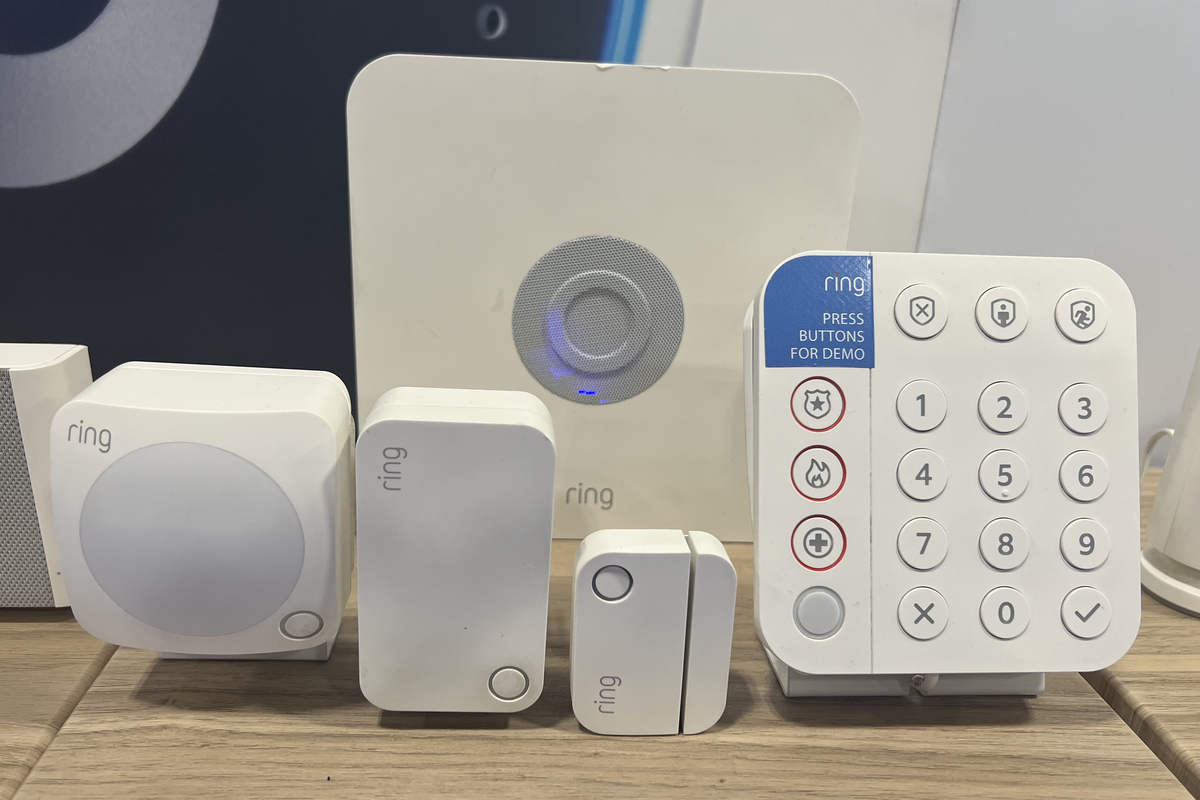
Featured image: a Ring Alarm base station, keypad and sensors on display, May 2023. This is existing Ring gear the new drone is designed to work with, not the drone itself. Photo: TaurusEmerald via Wikimedia Commons, licensed under CC BY-SA 4.0; cropped slightly to 3:2, resized and converted to PNG. The adapted image is shared under the same licence. Ring and Amazon trademarks are shown for editorial purposes and do not imply endorsement.